About Meryta sinclairii (Hook.fil.) Seem.
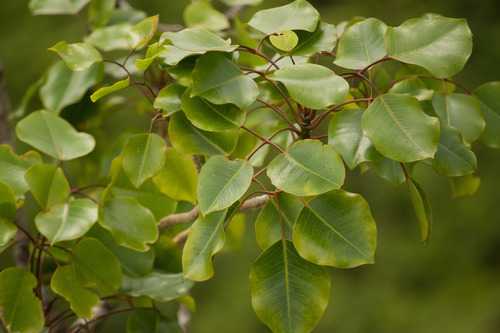
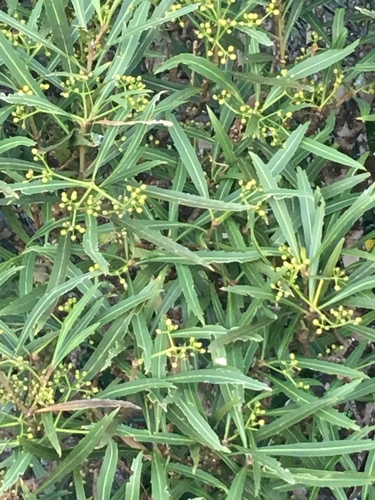
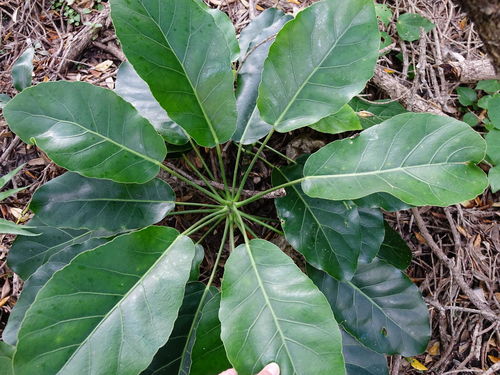
Meryta sinclairii, commonly known as puka, has elliptical, thick, leathery leaves that can grow up to 50 cm long and 20 cm wide, with a glossy upper surface. These are the largest entire leaves in the New Zealand flora. Its leaf stalks, called petioles, may reach up to 35 cm in length. Leaves are densely clustered in groups of 20 to 30 at the tips of branches, with a few large deciduous scales among the petioles of the youngest leaves. Young puka plants grow straight upward, but after flowering the tree begins to branch, typically forming a rounded crown. The tree produces panicles of green-white flowers, which are followed by black berries. Green-white flowers grow on erect terminal panicles up to 50 cm long, blooming from spring to autumn. The flowers are inconspicuous. Ball-bearing sized fruit only develops on female plants, though occasional bisexual flowers may occur. The fruit is roundish-oblong, black, shining, and slightly angled when young, becoming smooth as it matures. Each fruit contains 5 curved, highly compressed seeds that are roughly three-eighths of an inch long, black or dark-brown, and extremely hard. Fruits take a full year to mature; as they ripen to black, they attract birds. The entire plant is more or less resinous. Its dark-brown bark is covered in numerous warty growths, is easily wounded, and forms large callosities as it heals. The wood is white and brittle. Branches are very stout and marked with scars from fallen leaves. The trunk is either stout or slender, and is irregularly and sparsely branched. In 1869, Kirk recorded that puka was already established under cultivation. Today, it is widely grown as a street tree and garden specimen in northern New Zealand. The main propagation method is from seed, though cuttings can be grown with limited success. Puka grows well in full sun or light shade. It cannot tolerate frost, especially when young; leaves will be damaged if temperatures drop below −2 °C. Despite this sensitivity, it has been grown as far south as Dunedin when planted in protected locations. Puka is tolerant of wind, is unaffected by salt spray, and has high tolerance for coastal conditions. It can be trimmed to control its size, can be grown in large containers, and makes an ideal indoor plant when young. Meryta sinclairii var. 'Moonlight' is a variegated cultivar with very attractive cream and yellow leaves. It is less vigorous and less easy to grow than the wild, non-variegated form.