About Mertensia virginica (L.) Pers. ex Link
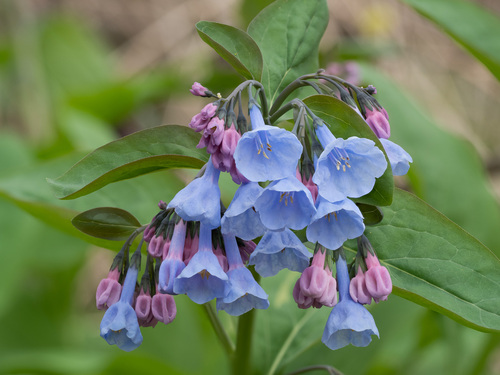
Mertensia virginica, commonly called Virginia bluebells, produces ovate, gray-green leaves on stems that grow up to 24 inches (60 cm) tall. Individual leaves reach up to 5 inches (13 cm) in length, have smooth entire margins, are petiolate on the lower portion of the flower stem, and are sessile on the upper portion. Its inflorescence is a nodding cyme, a cluster of flowers that grows at the end of arched stems. Flower buds are pink; opened flowers are typically light blue, occasionally pink, and very rarely white. Each flower has 5 shallow lobes that are fused into a tube at the base, five stamens, and a central pistil (carpel).
M. virginica is native to the United States, where its range extends west to Kansas, south to Mississippi, Alabama, and Georgia, and northeast to Maine. In Canada, it is native to Ontario and Quebec. It grows in rich, moist woods and on low, wooded hillsides, and often forms large colonies.
This species develops very early in spring and flowers in mid-spring. After flowering in early summer, each fertilized flower produces four seeds contained within wrinkled nuts. The plant then goes dormant until the following spring. Its flowers attract long-tongued bees such as bumblebees, as well as butterflies, moths, skippers, hummingbird moths, flower flies, bee flies, and hummingbirds.
Virginia bluebells had multiple uses in traditional Native American medicine. The Cherokee used it as a pulmonary aid, and to treat tuberculosis and whooping cough. The Iroquois used a root infusion as an antidote for poison, and a root decoction to treat venereal conditions. Native Americans also used it to make a tonic believed to help people recover when feeling unwell. All parts of Mertensia virginica, including its flowers, are edible. When cultivated as a garden plant, M. virginica has received the Royal Horticultural Society's Award of Garden Merit.