About Mertensia paniculata (Aiton) G.Don
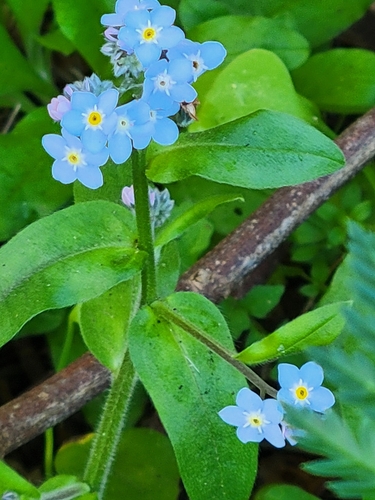
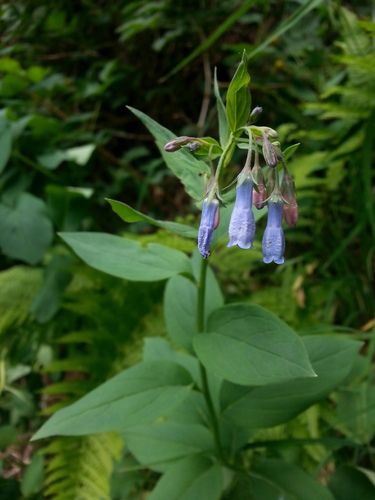
Mertensia paniculata (Aiton) G.Don, also commonly called northern bluebell or tall lungwort, grows as an herbaceous forb or subshrub. It produces one to several hairless or nearly hairless erect stems from a single long taproot, with stem lengths ranging from 0.1 to 0.7 meters. Basal leaves measure 0.05 to 0.2 meters long and 0.025 to 0.1 meters wide, and occur in a range of shapes from broadly elliptic-lanceolate to ovate-subcordate, tapering to an acute to acuminate apex. The lower leaf surface is either sparsely hairy or completely smooth, while the upper leaf surface may be completely smooth or covered in short, stiff, slender bristles. All leaves are simple, pinnately veined; basal leaf petioles range from 0.1 to 0.25 meters long, and petioles become winged moving up the stem. Leaves higher on the stem are 0.05 to 0.18 meters long and 0.01 to 0.08 meters wide, shaped broadly ovate to lanceolate with acuminate tips. Leaves are arranged alternately along the ascending stem. Flowers are arranged on one-sided branched inflorescences called scorpioid cymes, which take a spiral shape. This species is native to temperate North America, where it grows particularly well in boreal forests. It is found across Canada, including southern British Columbia. In the United States, it occurs in Alaska, the Olympic Mountains, and extends east through Oregon to Idaho and western Montana; the USDA PLANTS database also records populations as far east as Michigan, Wisconsin, and Minnesota. Mertensia paniculata grows best in moist woodlands and meadows. It is a shade-tolerant perennial species that occurs in both early and late-seral plant communities, and is most common in mid-succession. It has been observed growing in post-fire and post-logging areas of Alaska and Canada as part of early successional communities, and can regrow after these disturbances by sprouting from buried rhizomes or surface vegetative structures. It grows well in mesic, low-temperature soils with limited nutrient availability. In Yukon studies, it is a dominant species in areas with 230 mm of annual precipitation and an average annual temperature of −3 °C, and grows abundantly in the lower Yukon. It also grows near human homes in dry sunny, low-wind spots, as well as in meadows. Flowering occurs between May and September, varying by location. Its flowers are bisexual. Mature flowers have five blue petals forming the corolla, though young corollas are typically pink; mature white corollas occur rarely. The five sepals that form the calyx are linear-lanceolate, with cilia along the sepal margins. The lower sepal surface is either nearly hairless or covered in dense, short, stiff, bristle-like hairs. The corolla tube is 4.5–7 mm long, anthers are 2.2–3.3 mm long, and the style is equal to or longer than the corolla. The fruit consists of a cluster of 1 to 4 small, wrinkled, single-seeded nutlets, each 2.5–5 mm long. Mertensia paniculata can reproduce by sprouting: it forms clonal clones clustered around the parent plant, and has been observed spreading laterally via adventitious roots after fire. While its whole organs are not considered edible, it has historically been used as a pot-herb in northern regions and parts of Scotland, as it is a member of the borage family. It also has a history of medicinal use: dried leaves can be made into an herbal tea to stimulate the respiratory system.