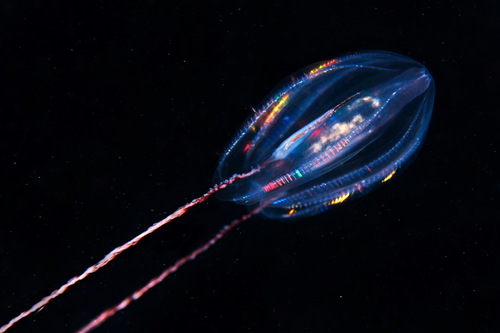
About Mertensia ovum (Fabricius, 1780)
Mertensia ovum, commonly called the Arctic comb jelly or sea nut, is a species of cydippid ctenophore (comb jelly). It was first described by Johan Christian Fabricius in 1780 under the name Beroe ovum, and it is the only species belonging to the genus Mertensia. Unlike most ctenophores which typically prefer warmer waters, M. ovum is native to the Arctic and adjacent polar seas, where it mostly lives in surface waters down to 50 metres (160 ft).
Mertensia ovum produces weak blue and green bioluminescence. It also displays a rainbow effect similar to the sheen of an oil slick, which is created when incident light interferes with the organism’s eight rows of moving cilia called comb rows. These comb rows propel the body, beat sequentially in a pattern similar to a Mexican wave, and also act as chemical sense organs that serve the same purpose as insect antennae. This species is the main source of bioluminescence among Arctic gelatinous zooplankton.
Like other ctenophores, M. ovum has a large body cavity and is carnivorous. It catches copepods and small crustaceans with two extremely sticky, robust tentacles, which classifies it in the group Tentaculata. These tentacles are long, contractile, and have many small side branches called tentilla that hold colloblasts. Each colloblast contains a coiled spiral filament that is structurally similar to a cnidarian nematocyst, but instead of injecting toxin, it releases an adhesive substance to trap prey. After catching prey, the tentacles can be pulled back into a specialized tentacle sheath.
The body of Mertensia ovum is generally light pink, oval-shaped along the tentacular plane, and significantly compressed along the sagittal plane. Its unusual nervous system consists of a nerve network located just under its outer skin, rather than a compact centralized brain. A research study conducted in the Barents Sea found that M. ovum eats prey ranging from small copepods to amphipods and krill, and its primary staple diet consists of large copepod species including Calanus finmarchicus, C. glacialis, C. hyperboreus, and Metridia longa.
Mertensia ovum is hermaphroditic, similar to garden snails. It most often reproduces sexually, but can occasionally reproduce asexually. Individuals release both eggs and sperm into open water, and ovoid larvae develop from fertilized eggs. The planktonic larvae of this species measure 2–3 millimetres (0.08–0.12 in) long, while fully grown adults can reach up to 10 centimetres (3.9 in) in length. In the Baltic Sea, the entire local population is made up of sexually active larvae.
The genus name Mertensia was chosen to honor German naturalist Karl Heinrich Mertens, also known as Andrei Karlovich Mertens, who lived from 17 May 1796 to 18 September 1830. In 1826, Mertens accompanied Russian naturalist Alexander Philipov Postels aboard the ship Senyavin on a voyage to reconnoiter and describe the coasts of Kamchatka, the lands of the Chukchi (Chuchkis) and Koryak (Koriaks) peoples — coasts that had not been described by anyone prior, and were unknown outside of Captain Bering’s earlier voyage. The voyage also aimed to survey the coasts of the Okhotsk Sea and the Shantar Islands, which were already known but not yet sufficiently described.

