About Mertensia lanceolata (Pursh) A.DC.
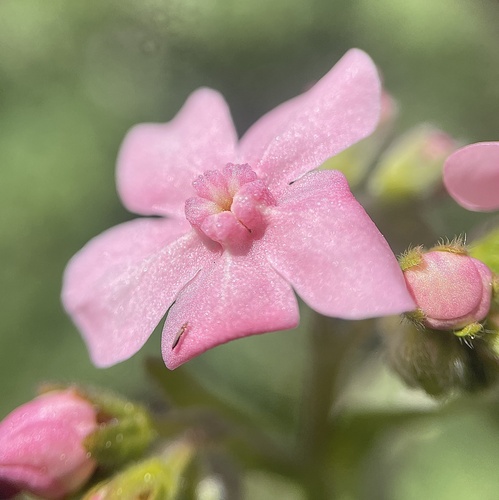
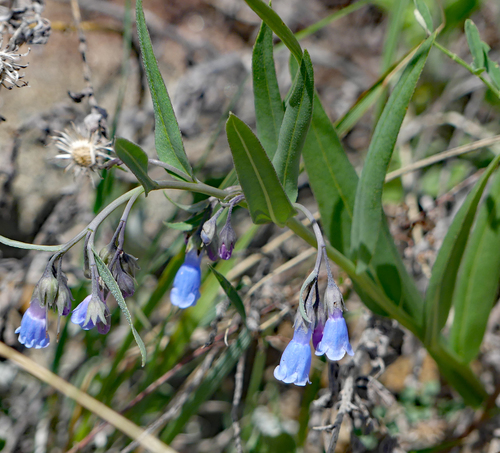
Mertensia lanceolata (Pursh) A.DC. is a variable species, where flowering individuals typically grow 10–45 cm tall. This species occurs in Rocky Mountain habitats, ranging from plains to alpine areas. Its leaves are blue-green from a waxy coating and have a prominent central vein. Immature plants produce a small number of basal leaves (growing directly from the ground) that are ovate-lanceolate, meaning their shape falls between egg-shaped and lance-head-shaped. These basal leaves may grow on short stalks that are longer than the leaf blade, or they may be sessile, meaning they have no leaf stalk at all. Older, flowering plants produce alternate leaves attached to the flower stalk; these leaves are much narrower, shaped either lanceolate or oblong-lanceolate (somewhat more rectangular), and older plants may or may not retain their basal leaves. All leaves and flower stalks grow from a large taproot. Flowering stalks lean outward at an angle, and multiple flowers hang downward from the top of the stalk. The flowers have five fused petals that form a short trumpet shape. Flower buds are pink, while open flowers are very often pale sky-blue, but may also be nearly white or deep blue. The united floral tube measures 3–7 millimeters in length. The inflorescence is densely packed with flowers when young, but becomes more widely spaced as it ages, taking on a paniculate structure. The flowering period lasts around one month, and may continue longer when growing conditions are favorable. Flowering timing depends on local weather, and occurs from April to August in the species' native habitat. Mertensia lanceolata becomes dormant by early summer, dying back to its large established root system. Mertensia lanceolata grows in the Rocky Mountains, ranging from northern New Mexico in the south to Alberta in Canada, and is found within the U.S. states of Colorado, Wyoming, Utah, and Montana. It also grows in areas east of the Rocky Mountains, in the Canadian provinces of Manitoba and Saskatchewan, and the U.S. states of Nebraska, North Dakota, and South Dakota. It grows in a wide variety of habitats, including forests, woodland edges, stream banks, prairies, rocky hillsides, and alpine tundra. In a study conducted after the Hayman Fire in Colorado, similar numbers of Mertensia lanceolata plants were recorded before and after the fire. Along Colorado's Front Range, this species is associated with areas with a history of low-intensity forest fires in ponderosa pine forests. Between 1981 and 1996, the species expanded its range in Colorado from lower mountain and upper montane forest life zones into alpine tundra, without colonizing the subalpine zone in between. Commonly called narrow-leaved languid ladies, this species is valued by wildflower gardeners for its dainty, vibrant blue flower display and long blooming period when adequate moisture is available. It grows well in both well-drained soils and clay soils, and is tolerant of limestone-derived soils. Plants live for many years when given enough space to grow their deep, branching taproot. Colorado State University Extension rates this species as having the lowest possible flammability for landscaping, making it suitable for creating fire defensible space. A germination study found that the species has very little requirement for cold stratification: 70% of seeds sprouted after four weeks at 21 °C (70 °F). However, germination was accelerated when seeds were held at 4.5 °C (40.1 °F) for three months before planting; cold-treated seeds reached a 30% germination rate after just two days. The species is winter hardy to USDA zone 4. Plants are rarely available from commercial growers, and even its seeds are somewhat uncommon in wildflower seed exchanges.