About Mertensia ciliata (James ex Torr.) G.Don
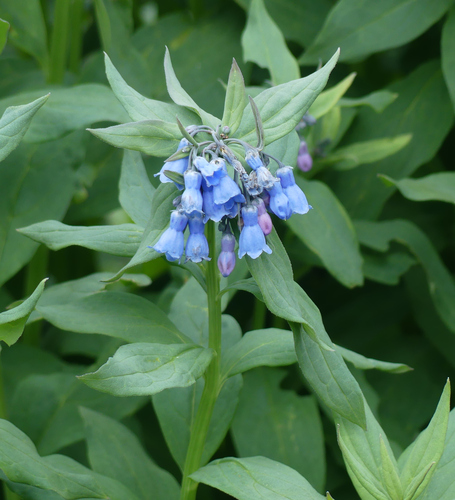
Mertensia ciliata (James ex Torr.) G.Don is a perennial herb that grows a cluster of erect stems from a thick, branching caudex. Its leafy stems reach a maximum height of well over one meter. The leaves are veiny, oval to lance-shaped, and can grow up to 15 centimetres (6 inches) long. It blooms from May to August, producing an open inflorescence made up of many clustered blue bell-shaped flowers. Each flower is between 1 and 2 cm (1⁄2 and 3⁄4 in) long, hanging, fragrant, and tubular in shape, expanding into a wider, lobed mouth. Individual flowers change color from blue to pink-red as they age. This species is native to the western United States, where it occurs in California, Nevada, Utah, and Oregon. It often grows in moist habitats, including subalpine meadows and creeksides. It frequently forms large carpets of blue-green foliage and sweet-scented bluebell blooms across meadows and hillsides. The flowers of Mertensia ciliata have poricidal anthers, and are fertilized through buzz-pollination by several bumblebee (Bombus) species. Primary nectar robbing by Bombus species, including B. occidentalis, is common in some populations. The flowers, young stems, and young leaves of Mertensia ciliata are edible when eaten raw. Older leaves, which develop as the plant becomes hairy, should be cooked before consumption. The plant contains alkaloids, so it should not be eaten in large quantities.