About Merops viridis Linnaeus, 1758
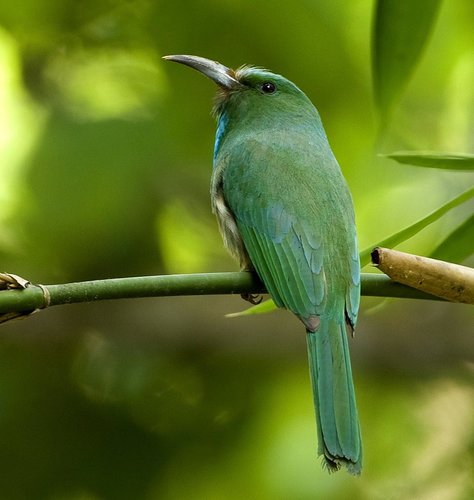
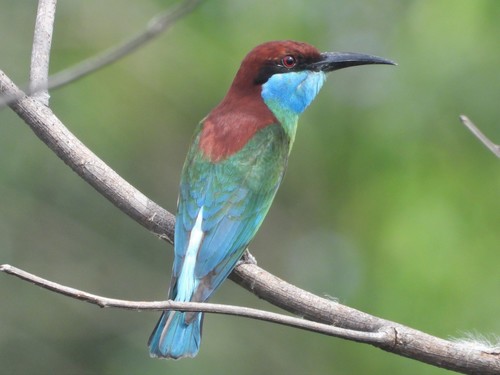
Description. Adult blue-throated bee-eaters (Merops viridis) measure around 21 cm in length, not counting their elongated central tail feathers, which add an extra 9 cm. Adults weigh approximately 34 to 41 grams. Adult blue-throated bee-eaters have striking plumage: they have a red-brown crown and nape, dark green wings, a blue tail, light green breast and belly, and the characteristic blue throat that gives the species its name. Juveniles are almost entirely green across their whole body, and do not develop full adult plumage until later. Juveniles have a dark green head and wings, and a light green breast, and they also lack the elongated central tail feathers that adult birds have. Both adult and juvenile blue-throated bee-eaters have black eye stripes. Their eye color ranges from red to brown, or a mix of the two shades. Distribution and habitat. This species has a broad distribution that extends from southeastern China to the Greater Sundas Islands. The most concentrated populations are found in Singapore, Malaysia, southern Cambodia, and southern Thailand. More scattered populations occur in Borneo and Java. Blue-throated bee-eaters are most widespread at low altitudes, between 0 and 670 m, but have been recorded living as high as 1,600 m. They occupy a wide variety of open, flat habitats including farmland, suburban gardens, riversides, dunes, and sandy clearings. In winter, some blue-throated bee-eaters move into forest canopies and the saltwater channels of mangrove forests. Unlike most bee-eater species, which dig nest burrows into near-vertical sand cliffs, blue-throated bee-eaters usually dig their nest burrows nearly horizontally into flat ground. Colonies can range in size from 50 to 200 breeding pairs, though the species may also live completely solitary in open country. Food and feeding. Blue-throated bee-eaters feed primarily on flying insects such as bees and wasps. However, dragonflies make up a large percentage of their diet. The species has the highest hunting success on sunny days. Other insects they catch include flies, beetles, and other bugs up to 42 mm in size. Observations have recorded no feeding activity during rain, or immediately after rain showers. The species' feeding patterns align closely with seasonal weather patterns. The highest feeding rate occurs during the breeding season, which coincides with the sunniest period of the year that comes right after the rainy season.