About Merops variegatus Vieillot, 1817
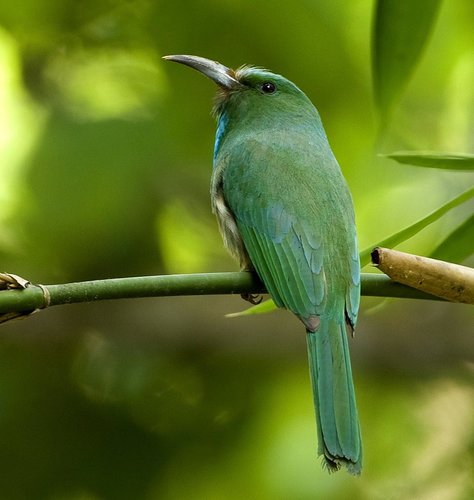
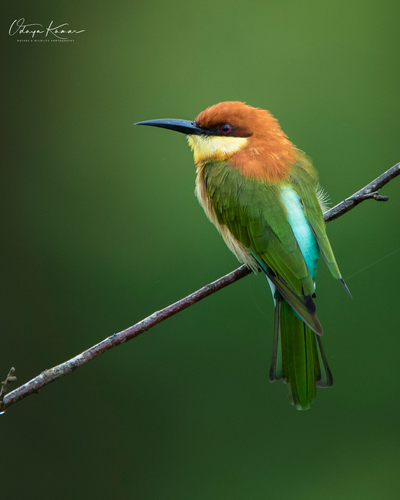
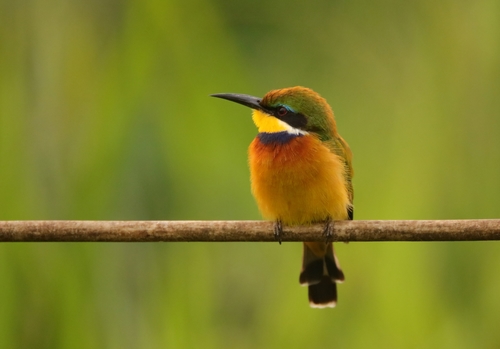
The blue-breasted bee-eater, scientifically named Merops variegatus, shares several key physical traits of the Meropidae family. It has a relatively large head, short neck, bright plumage, a long curved slender sharp beak, and a broad black eyestripe. This species weighs between 20 and 26 grams and measures 18 to 21 centimeters in total length. Its body is primarily green: it has a green crown, green upperparts, and light greenish-yellow underparts. The primary wing feathers are tinted rufous, while secondary feathers are green with black tips. Compared to the pointed wingtips of migratory Meropidae species, the wingtips of M. variegatus are rounded. Its tail holds twelve rectrices: outer rectrices are tinted rufous, and central tail feathers are green. The tail has a subterminal black bar, white tips, a shallow V-shape, and lacks the tail-streamers found in other members of the Meropidae family. A specific combination of head characteristics distinguishes the blue-breasted bee-eater from other Meropidae members: it has a blue stripe above the black eyestripe, an orange-red iris, a white cheek, and a bright yellow throat. Like many other bee-eaters, it has a wide chest band, which is two-toned: a deep purple-blue gorget sits above a chestnut-colored breastband. Juvenile blue-breasted bee-eaters have buff flanks and belly, a yellow-buff chin that leads to a light green mottled breast, and completely lack a chest band. Blue-breasted bee-eaters are distributed across multiple central African countries, including Angola, Zambia, Tanzania, Uganda, the Democratic Republic of the Congo, Nigeria, and Cameroon. Within this range, they occupy a variety of habitats, from reedy lake shores to savanna grasslands bordering the Congo basin. They have also been recorded in marshes, grassy hillsides, and papyrus beds, and the species is most commonly associated with open wet habitats. Mating timing for blue-breasted bee-eaters varies by geographic location across their range: breeding occurs from February to March in the northern parts of the range, October to December in the eastern range, September to October in the southern range, and August to September in the western range. Nests are dug into grassy hillsides or eroded lake shores. Each nest is a tunnel 45 to 75 centimeters long that opens into an unlined egg chamber, which measures 17-70 by 18–22 centimeters. Eggs are incubated in this unlined chamber. While many Meropidae species practice cooperative breeding, the blue-breasted bee-eater is a solitary, monogamous breeder. A mated pair produces 2 to 3 eggs per clutch. After young blue-breasted bee-eaters fledge the nest, parents and offspring remain highly social, staying together until the start of the next breeding season.