About Merops pusillus P.L.S.Müller, 1776
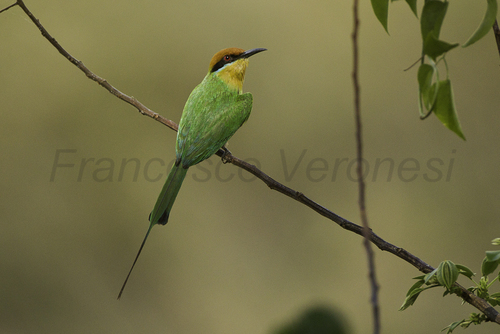
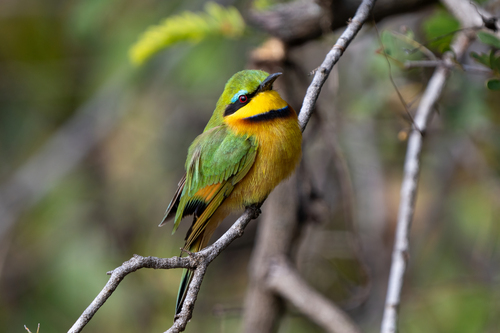
Like other bee-eaters, little bee-eaters (Merops pusillus P.L.S.Müller, 1776) are slender, richly and brightly coloured birds. They have green upper parts, yellow throats, black gorgets, and rich brown upper breasts that fade to buffish ochre on the belly. Their wings are green and brown, and their beaks and legs are black. They reach a total length of 15–17 cm, making them the smallest species of African bee-eater. The sexes of this species look identical. These birds are often silent, and their call is a soft "seep". Little bee-eaters are abundant, tame birds that are commonly seen throughout their range. The global population is estimated at between 60 and 80 million individuals. They breed in open country with bushes, and prefer breeding sites located near water. As the common name "bee-eater" suggests, these birds predominantly eat insects, especially bees, wasps, and hornets. They catch insect prey in flight by launching sorties from an open perch, and this species often hunts from low perches that may be only one metre or less above ground. Before consuming a captured insect, a bee-eater removes the stinger by repeatedly hitting the insect against a hard surface. Unlike most other bee-eater species, little bee-eaters nest as solitary pairs. They dig a nesting tunnel into sandy banks, or sometimes use the entrance to an aardvark den as a nesting site. They lay 4 to 6 spherical white eggs. Both the male and the female share care of the eggs. These birds roost communally, lining up side-by-side on tree branches to roost.