About Merops persicus Pallas, 1773
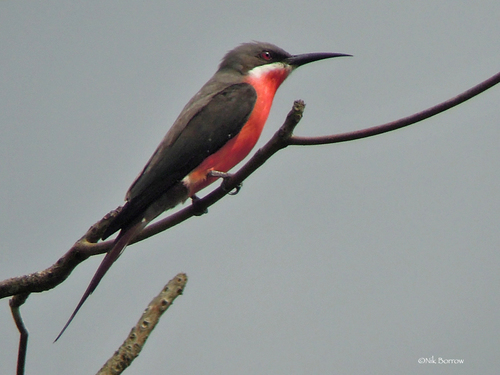
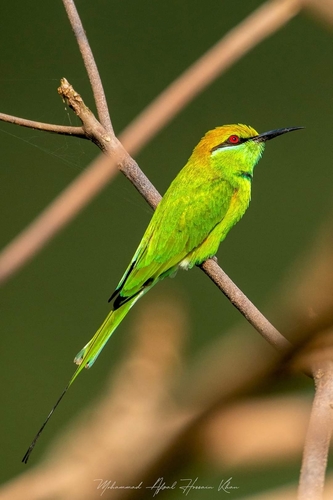
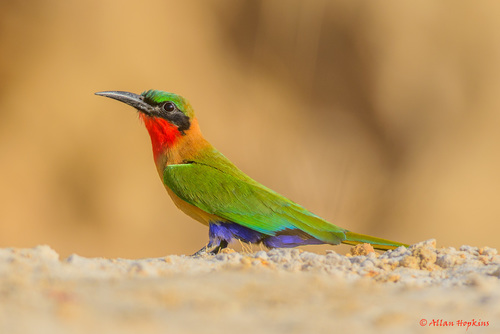
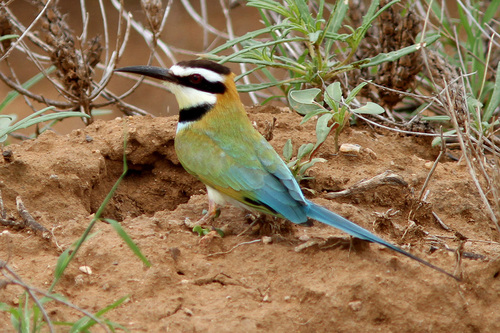
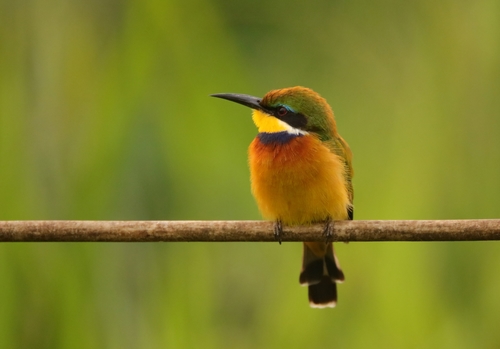
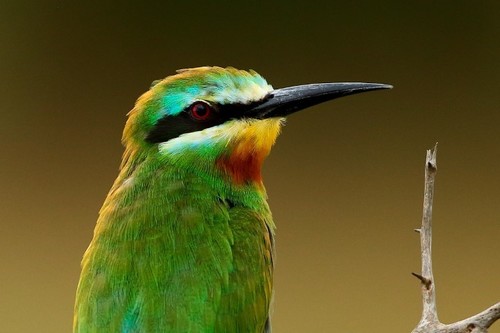
Merops persicus Pallas, 1773, commonly known as the blue-cheeked bee-eater, is a richly coloured, slender bird similar to other bee-eater species. Its plumage is predominantly green; the sides of its face are blue, it has a black eye stripe, and its throat is yellow and brown, while its beak is black. Adults can reach a body length of 31 cm (12 in), and the two elongated central tail feathers add an extra 7 cm (2.8 in) to this total. Males and females look mostly alike, but the elongated tail streamers of the female are shorter than those of the male. This bird breeds in sub-tropical semi-desert habitats that have a small number of trees, such as acacia. It spends the winter in open woodland or grassland. As bee-eaters, these birds predominantly eat insects, especially bees, wasps, and hornets, which they catch mid-flight after launching sorties from an open perch. However, this particular species likely eats more dragonflies than any other food item. If available, the species prefers to use telephone wires as its hunting perch. Blue-cheeked bee-eaters may nest either alone, or in loose colonies of up to ten birds. They may also nest in shared colonies with European bee-eaters. Their nests are built in sandy banks, embankments, low cliffs, or along the shore of the Caspian Sea. They dig a relatively long tunnel 1 to 3 m (3–10 ft) long, and lay four to eight, usually six or seven, spherical white eggs inside this tunnel. Both the male and female care for the eggs, but only the female incubates the eggs at night. Incubation lasts between 23 and 26 days. The call of this species sounds flatter and less fluty than the call of the European bee-eater.