About Merops orientalis Latham, 1801
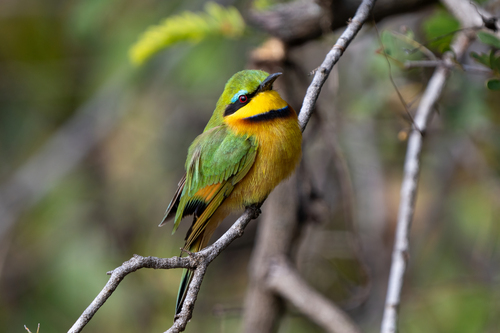
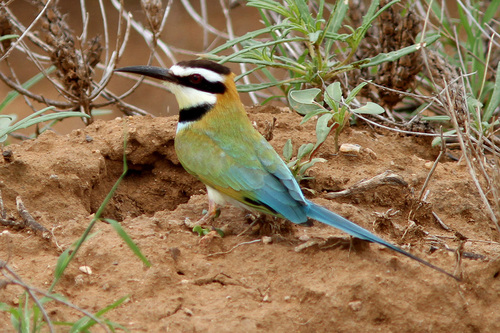
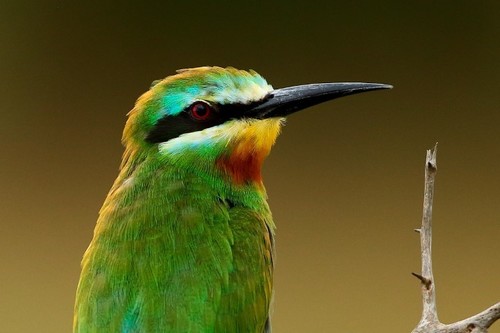
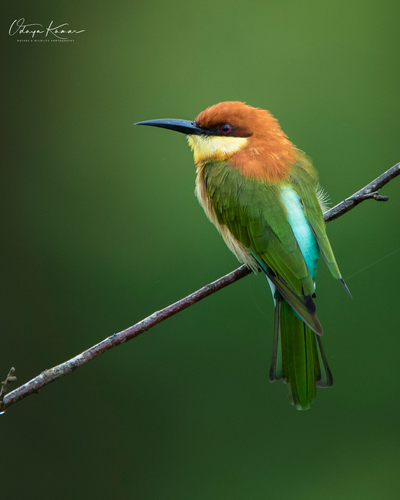
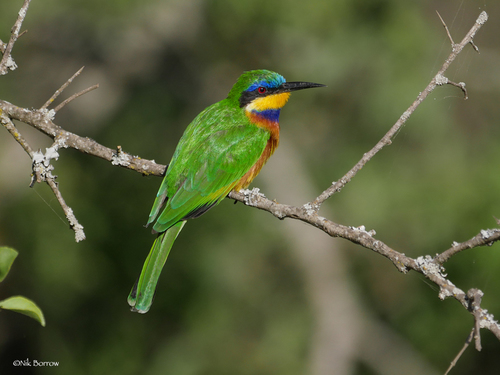
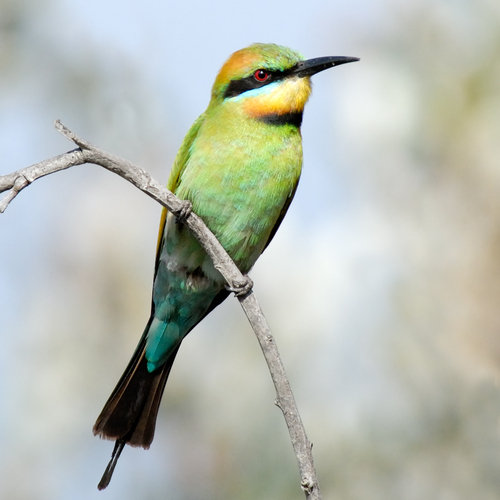
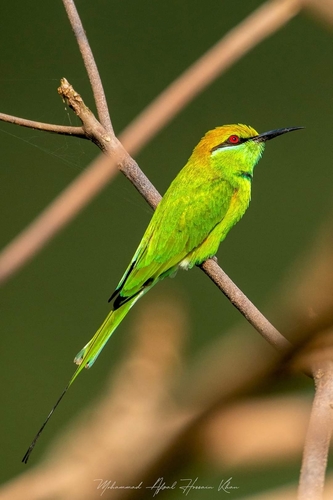
Like other bee-eaters, Merops orientalis Latham, 1801 is a slender, brightly coloured bird. It measures 16–18 centimetres (6.3–7.1 in) in length, not counting the elongated central tail feathers that add an extra 7 cm (2.8 in). All of its plumage is bright green, with a blue tinge that is especially noticeable on the chin and throat, while the crown and upper back have a golden rufous tinge. Its flight feathers are rufous with a green wash, and are tipped with blackish colour. A thin black eyestripe runs in front of and behind the eye, and a slender black crescent marking sits on the upper breast just below the throat. This species has a crimson iris, a black bill, and dark grey legs. Its feet are weak, with three toes connected at the base. Birds found in Southeast Asia have a rufous crown and face, with green underparts, while the western subspecies M. o. beludschicus has a greener crown, bluer face, and bluish underparts. In flight, the upper surface of the wings is bronzed coppery-green, and the under surface is coppery-orange. Juvenile birds are paler and duller overall; they do not have elongated tail feathers or the black throat crescent, and their throat is yellow-tinged instead of blue-toned. The sexes of this species are identical in appearance. Its call is a nasal trill, described as tree-tree-tree-tree, which is usually produced during flight. Leucistic individuals of this species have been recorded. This is an abundant, fairly tame bird that is well-known across its range. It breeds in open country with bushes, and often hunts from low perches that may be only one metre high or less. It readily uses fence wires and electric wires as perches. Unlike some other bee-eater species, it can be found far from water. It is mostly seen in plains, but may sometimes occur up to 2,000 m (6,600 ft) in the Himalayas. It is resident in the lowlands of South Asia, but some populations make seasonal movements whose patterns are not well understood; these populations move to drier regions during the rainy season, and to warmer regions in winter. In parts of Pakistan, it is a summer visitor. Like other species in the Merops genus, green bee-eaters eat mostly insects, especially bees, wasps, and ants, which they catch in the air by launching sorties from an open perch. Before swallowing their prey, bee-eaters remove stings and break the prey’s exoskeleton by repeatedly striking it against the perch. While the species is not considered migratory, it makes seasonal movements in response to rainfall. These birds are somewhat sluggish in the early morning, and may be found huddled next to one another on wires, often with their bills tucked into their backs, long after sunrise. They sand-bathe more often than other bee-eater species, and will sometimes bathe in water by dipping into it while flying. They are usually seen in small groups, and often roost communally in flocks of 200 to 300 individuals. At the roost site, the birds move excitedly and call loudly, often dispersing suddenly before settling back onto the roost tree. This species, also called the little green bee-eater, is becoming increasingly common in urban and suburban neighborhoods, where it has been observed perching on television antennae. It will launch into a short, zig-zag flight to catch an insect, then return to the same perch to eat its meal. This behaviour is generally seen between 7:00 and 8:00 a.m., and after 4:00 p.m. The breeding season runs from March to June. Unlike many other bee-eaters, this species often nests alone, digging a tunnel into a sandy bank. Breeding pairs are often assisted by helper birds. They nest in hollows in vertical mud banks. The nest tunnel they build can be as long as 1.5 metres (5 ft), and 3 to 5 eggs are laid on the bare ground in the cavity at the end of the tunnel. The eggs are very spherical and glossy white. Clutch size changes with rainfall and the density of insect prey. Both sexes incubate the eggs. The eggs hatch asynchronously, with an incubation period of around 14 days, and the chicks fledge 3 to 4 weeks after hatching; chicks show a reduction in body weight during the fledging stage. One study has suggested that green bee-eaters may be able to interpret the behaviour of human observers. They showed an ability to predict whether a human in a specific location could spot their nest entrance, and adjusted their behaviour to avoid revealing the nest location. The ability to understand a situation from another being’s point of view was previously thought to be unique to primates. In southern India, riparian habitats support high population densities of this species, reaching 157 individuals per square kilometre (410 per square mile). Density drops to 101 individuals per square kilometre (260 per square mile) in agricultural areas, and 43 to 58 individuals per square kilometre (110 to 150 per square mile) near human settlements. Because they feed on flying insects, they can sometimes be a nuisance to beekeepers. Their preferred prey is mostly beetles, followed by hymenopterans; they appear to avoid orthopterans. They have sometimes been recorded eating crabs. Like most other birds, they regurgitate the hard, indigestible parts of their prey as pellets. An endoparasitic nematode, Torquatoides balanocephala, sometimes infects their gizzard. A protozoal blood parasite, Haemoproteus manwelli, has been described from this species in India.