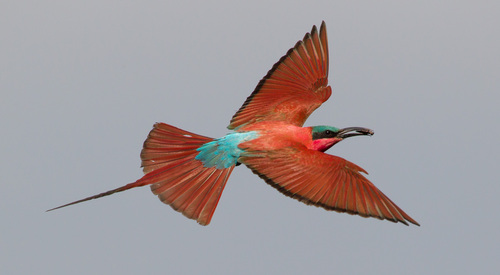
About Merops nubicoides Des Murs & Pucheran, 1846
Like other bee-eaters, Merops nubicoides is richly coloured. Its body is predominantly carmine, while its crown and undertail are blue. This bird, known as the southern carmine bee-eater, ranges from KwaZulu-Natal and Namibia north to Gabon, eastern Democratic Republic of the Congo, and Kenya. It is a migratory species. It spends the breeding season from August to November in Zimbabwe and Zambia, then moves as far south as South Africa for the summer months, and migrates to Equatorial Africa from March to August. Its typical habitat is low-altitude river valleys and floodplains. When breeding, it prefers vertical banks that are suitable for tunneling, but it will readily dig vertical burrows into the level surface of small salt islands. This species is highly sociable, gathering in large flocks both during and outside of the breeding season. It roosts communally in trees or reedbeds, and disperses widely across the landscape during the day. Nests are located at the end of 1 to 2 meter long burrows dug into earthen banks, and 2 to 5 eggs are laid per nest.