About Merops leschenaulti Vieillot, 1817
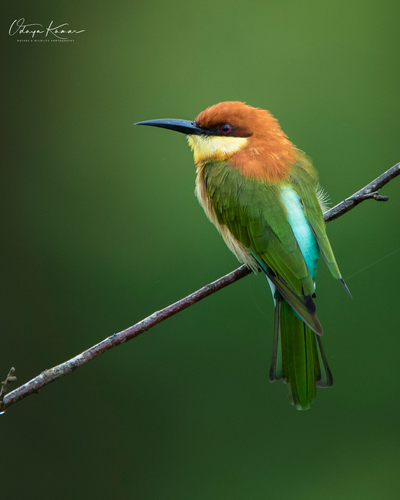
Chestnut-headed bee-eater (scientific name Merops leschenaulti Vieillot, 1817) has an overall length of 18–20 cm (7.1–7.9 in) and weighs 26–33 g (0.92–1.16 oz). Males and females have similar appearances. On adults, the forehead, crown, nape, mantle, and ear-coverts are bright chestnut. The lores are black, extending as a thin band under the eye and ear-coverts. Wing coverts, the lower back, and tertials are green, with tertials tipped bluish. The rump and uppertail coverts are pale shining blue. Primaries and secondaries are green, with rufous inner webs, and all are tipped dusky. Central tail feathers are bluish on the outer webs and green on the inner webs; all other tail feathers are green, with brown margins on the inner webs, and all are tipped dusky. The sides of the face, chin, and throat are yellow. Below this yellow area, a broad chestnut band extends to the sides of the neck and connects to the chestnut upper plumage. Further down, there is a gorget made of a short, distinct black band followed by an ill-defined yellow band. The rest of the lower plumage is green tipped with blue, with the blue tint most prominent on the vent and undertail coverts. Adults have red irises, black bills, dusky black legs, and dark horn-coloured claws. Juveniles resemble adults but have duller coloration: they have a green forehead, forecrown, and mantle, their lower throat is yellow instead of chestnut, their gorget band is indistinct, and their breast and belly are paler and more olive-toned than adults. The Javan subspecies M. l. quinticolor differs from the nominate form: the area from the bill down to the black pectoral band is pure yellow with no chestnut, and it has an entirely blue tail. The race andamanensis, found in the Andamans, is slightly larger than the mainland Indian population. This bird breeds in subtropical open woodland, and it is most common in highland areas. As its common name suggests, bee-eaters predominantly eat insects, especially bees, wasps, and hornets. They catch these prey in the air by launching sorties from an open perch. There are recorded instances of this species feeding on fish by flying over water.