About Merops cyanophrys (Cabanis & Heine, 1860)
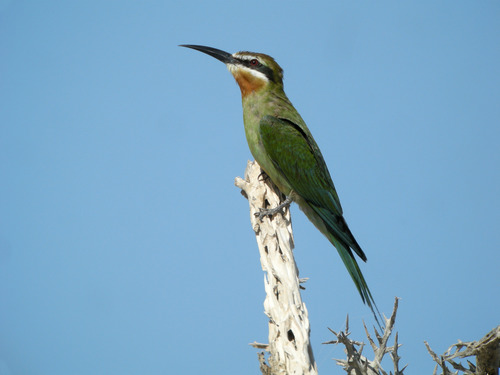
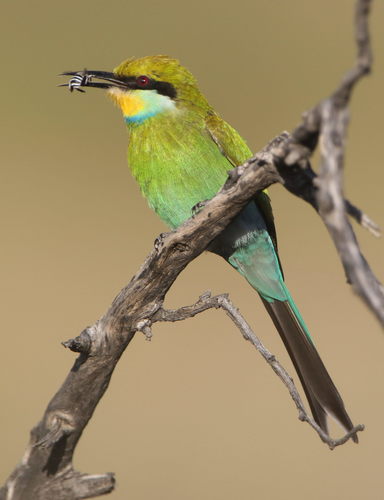
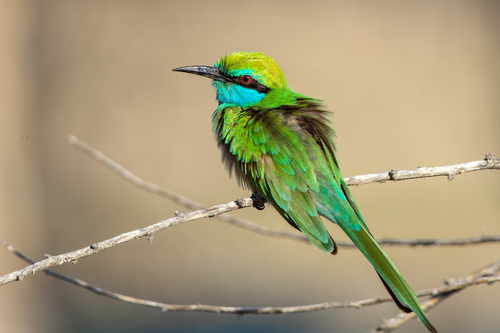
This bird species has a body length of 16–18 centimetres (6.3–7.1 in), not counting its elongated central tail feathers, which add an extra 2 cm (0.8 in) to its total length. The plumage of its head and back is mostly dull green. Notable markings include a slender black eyestripe, a broad blue forehead, a blue stripe running above the black eyestripe, a clearly visible blue throat, and a broad black crescent on the upper breast just below the throat. The breast and the rest of the underparts are blue-green in color. This species' most distinctive features are its brighter blue throat and face, which is more intensely colored than the same areas on either Merops orientalis or Merops viridissimus, and its shorter central tail feathers. The upper surfaces of its wing and tail feathers are bronzed coppery-green, while their undersides are coppery-orange. The iris is red, the bill is black, and the legs are dark grey. Juvenile birds are paler and duller across their entire bodies, and do not have the elongated tail feathers or the black crescent on the throat. This species can also be distinguished from M. orientalis and M. viridissimus by its voice. The subspecies M. c. muscatensis differs from the nominate subspecies M. c. cyanophrys by having slightly more yellowish-green plumage on its upperparts, and a slightly narrower black crescent on the upper breast. This species lives in patchily distributed populations across arid, open regions of the Middle East that have scattered trees. It can also be found in wadis, gardens, and farmland, but it avoids completely barren desert. Agricultural expansion and irrigation have created new suitable habitat for this species, leading to an increase in its population. This population growth allowed the species to spread into parts of the Levant, including eastern Israel, western Jordan, and a very small section of the Sinai Peninsula, before 2001. Because of its growing population and the benefits it gains from human modification of habitats, it is not considered to be under any threat of extinction.