About Merops bulocki Vieillot, 1817
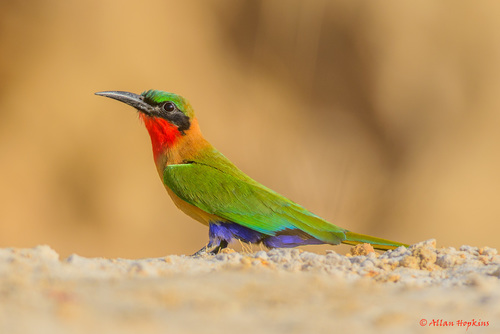
This species, the red-throated bee-eater, has the scientific name Merops bulocki Vieillot, 1817. Adult red-throated bee-eaters reach a total length of 20 to 22 cm (8 to 9 in), with a moderately long tail that lacks the elongated central streamers present in some other bee-eater species. Their upper body plumage is green, and their distinctive chin and throat are red; around 1% of individuals have a yellow throat instead. Their hind neck, breast, and underparts are buff-colored, while their undertail coverts and thighs are bright blue. Birds east of the Central African Republic have blue facial plumage, while birds west of the country have green facial plumage. The red-throated bee-eater has a broad range across tropical Africa, extending from Senegal and Gambia in the west to Uganda, southern Sudan, and Ethiopia in the east. Its typical habitat includes savannah with scattered trees, tree-dotted farmland, marsh edges, bushy pastures, and gardens. It is rarely found far from erosion gullies, streams, and small rivers, where it nests in the banks of these watercourses. The red-throated bee-eater is a colonial species that nests in groups and stays in its nesting area year-round. Nests are tunnels dug into river banks before the ground dries out after the rainy season, and colonies can hold up to around fifty nests. Its diet is mostly made up of honey-bees and stingless bees, alongside other types of insects. When foraging, individuals travel in pairs or small groups, and they may sometimes be seen perched side by side in a row. The species epithet bulocki honors William Bullock, from whose collection the species was originally described.