About Merops bullockoides A.Smith, 1834
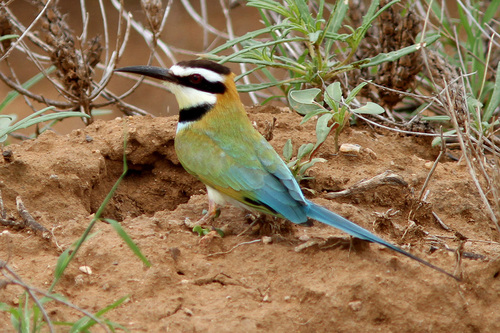
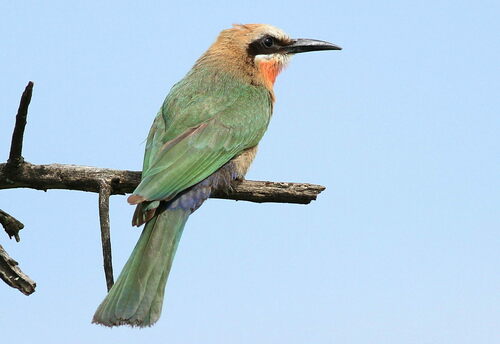
Like other bee-eaters, this species is a richly coloured, slender bird. It has distinctive features including a black mask, white forehead, square tail, and a bright red throat. It measures 23 cm (9 in.) in size. Its upperparts are green, while its underparts are cinnamon. Its call is a deep squeak. White-fronted bee-eaters are found across the large savannah regions of sub-equatorial Africa. They typically live in open country, often near gullies, an environment where their prey (bees) live. White-fronted bee-eaters nest in colonies that average 200 individuals. They dig roosting and nesting holes in cliffs or earthen banks. A population of these bee-eaters may range across many square kilometres of savannah, but all return to the same colony to roost, socialize, and breed. This species has one of the most complex family-based social systems observed in birds. Colonies are made up of socially monogamous, overlapping-generation extended family groups called "clans", which practice cooperative breeding. Non-breeding individuals act as helpers to relatives, helping to raise their brood. This helping behaviour is particularly well-developed in white-fronted bee-eaters: helpers assist in half of all nesting attempts. Helpers may contribute to every stage of the reproductive effort, from digging the roosting or nesting chamber, to allofeeding the female, incubating eggs, and feeding young. Their help greatly increases the number of young successfully produced. Only about 50% of non-breeders in a colony typically become helpers. Whether an individual becomes a helper, and which pair it assists, depends heavily on how closely related the individual is to the breeders. Non-breeders are most likely to become helpers when the breeding pair are their close genetic relatives. When choosing between potential nests to help at, helpers preferentially assist the breeding pair they are most closely related to. This suggests the behaviour may help increase the helper's inclusive fitness. When female white-fronted bee-eaters leave their nesting burrows, they must avoid being pursued by unmated males. These unmated males may force females to the ground and rape them. These unwanted advances are specifically targeted at females who are laying eggs, meaning the rapist may successfully fertilize the female's eggs instead of her mate.