About Merops americanus P.L.S.Müller, 1776
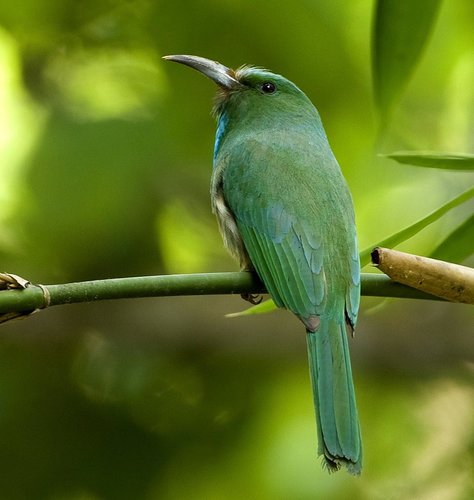
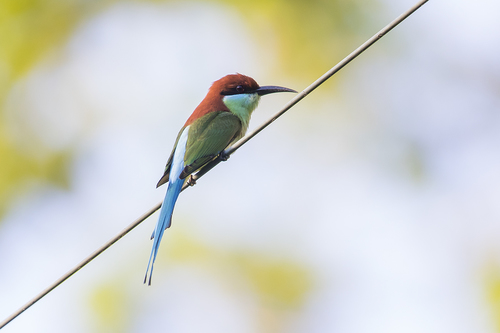
Merops americanus P.L.S.Müller, 1776 was previously classified as a subspecies of the blue-throated bee-eater (M. viridis). In 2014, the IUCN Red List and BirdLife International split it into a separate distinct species, and the International Ornithological Congress accepted this classification in 2022. It is still frequently confused with M. viridis, and many sources including eBird still refer to it as blue-throated bee-eater. It can be distinguished from M. viridis by its red-brown crown and mantle (instead of dark brown), and its paler greenish-blue throat and cheeks (instead of dark blue). This species lives in open country and clearings next to forested areas, including scrub and cogon fields. It uses dead trees and telephone wires as perches. The IUCN Red List has assessed Merops americanus as a least-concern species, because it is common and can tolerate open modified habitats. This species has not yet been studied in depth. It is presumed to be an insectivore, and as a bee-eater, it feeds heavily on bees. Bee-keepers consider this species a pest. It breeds from February to May, digging communal nest burrows in sloping ground and banks. These nesting tunnels can reach up to 1 meter deep. The average clutch size for this species is 3 to 5 eggs.