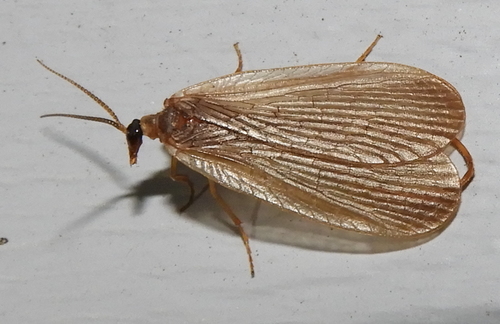
About Merope tuber Newman, 1838
Merope tuber, commonly called the earwigfly or forcepfly, is the only species in the genus Merope, and the only extant member of the family Meropeidae in North America. Its range extends across eastern North America, from Ontario south to Georgia, and west to Kansas; this species has recently also been discovered in Florida. The most prominent distinguishing feature of this insect is the large genital forceps located on the male abdomen, which closely resembles the cerci found in earwigs. Very little is known about adult Merope tuber. Adults are nocturnal, secretive insects that are sometimes found under logs, captured in malaise traps near streams, or drawn to artificial lights at night. No larvae of M. tuber or any member of the Meropeidae family have ever been identified. Morphologically, Merope tuber is marked by long wings with numerous veins, and it has no ocelli. It possesses a region of interlocking sclerites that connects the jugum and scutellum on the middle thoracic segment. Researchers hypothesize this structure may function to hold the wings together when the insect pushes up through dirt. A similar structure occurs in cicadas and ground-dwelling beetles, supporting the idea that winged adult Merope tuber may dig in soil. The insect’s flattened body shape, along with its lack of ocelli, suggests it lives close to the ground within cracks and other small openings in the ground.

