About Merluccius productus (Ayres, 1855)
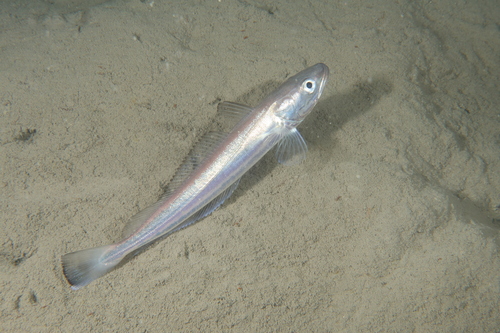
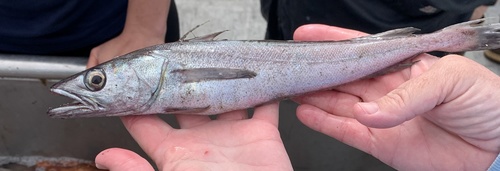
Merluccius productus, commonly called North Pacific hake, reaches about 3 feet (90 cm) in length and can live up to 20 years. Its body is metallic silver-gray with black speckling, and its belly is pure silvery white. This species has two dorsal fins, a truncated and always concave caudal fin, and the tips of its pectoral fins usually reach or extend beyond the origin of the anal fin. North Pacific hake spawn between January and June, and they may spawn multiple times per season, making it difficult to determine absolute fecundity. Historically, inshore female North Pacific hake matured at 15 inches (37 cm) and 4 to 5 years of age. Currently, the length at which 50% of females are mature in the Port Susan North Pacific hake population is about 8.5 inches (21.5 cm), which is lower than the 11.7 inches (29.8 cm) recorded in the 1980s. Overall, females mature at 3 to 4 years of age and 13.4 to 15.7 inches (34 to 40 cm), while nearly all males are mature by age three and can mature at sizes as small as 11 inches (28 cm). North Pacific hake are found from the surface down to depths of 1,000 m (3,300 ft). They are nocturnal feeders that perform daily vertical migrations upward off the bottom to feed on a variety of fishes and invertebrates, including shrimp, plankton, and smaller fish such as lanternfish. They are an important prey species for sea lions, small cetaceans, and dogfish sharks. There are three recognized stocks of Pacific hake: a highly migratory offshore (coastal) stock ranging from southern California to Queen Charlotte Sound, a central-south Puget Sound stock, and a Strait of Georgia stock. Between the 1960s and 1980s, the offshore North Pacific hake stock spawned off south-central California to Baja California in January and February. During spring and summer, adults migrated northward to feed as far as central Vancouver Island, and sometimes as far as Queen Charlotte Sound in some years. In fall, adults migrated southward back toward spawning grounds. Since the early 1990s, a portion of the offshore stock has remained off the west coast of Canada year-round, and some North Pacific hake have been observed spawning off the west coast of Vancouver Island. Resident North Pacific hake in Puget Sound spawn in Port Susan and Dabob Bay from February through April. The Strait of Georgia resident stock aggregates to spawn in the deep basins of the south-central strait, with peak spawning occurring from March to May.