About Merluccius merluccius (Linnaeus, 1758)
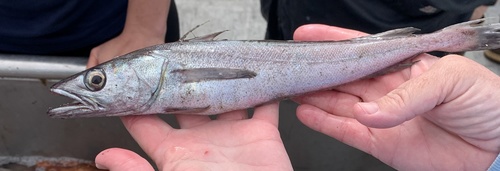
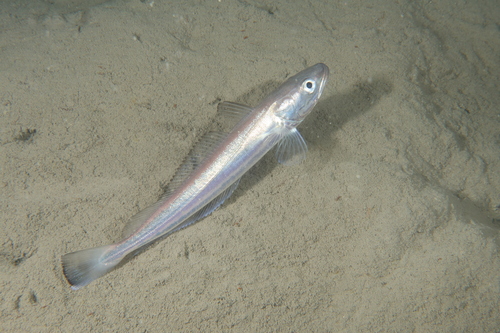
Merluccius merluccius (Linnaeus, 1758) is a slim-bodied fish with a large head and large jaws that hold a number of large curved teeth: the lower jaw has two rows of teeth, while the upper jaw has one row. The inside of the mouth and the branchial cavity are black, and the body is widest just behind the head. It has two dorsal fins: the first is triangular, high, and short-based, while the second is long, nearly the same length as the anal fin. Both the second dorsal fin and the anal fin have a slightly convex outline. The first dorsal fin has one spine and 7 to 10 fin rays; the second dorsal fin has 36 to 40 fin rays, and the anal fin also has 36 to 40 fin rays. In young fish smaller than 20 cm (7.9 in) in standard length, the tips of the pectoral fins extend to the level of the anal fin’s origin; this is not the case in adult individuals. The caudal fin is well developed with a truncate margin. The lateral line is straight and darker than the surrounding body color. Its back is blue-grey, its flanks are silvery, and its underside is whitish. It can grow to 180 cm (71 in) in length, though this is rare, and a more common maximum size is 100 cm (39 in).
Merluccius merluccius occurs in the eastern Atlantic Ocean, from Norway and Iceland, south along the European coast to the Strait of Gibraltar, and continues south along the west coast of Africa to Mauritania. It is also found throughout the Mediterranean Sea. It is present in the Black Sea, but restricted to the southern and western shorelines, specifically Bulgarian Black Sea waters near Cape Emine. In the Baltic Sea, it does not normally extend east of the Kattegat, though it has been recorded as far east as Lithuania.
Commonly called European hake, this species normally lives at depths between 70 m (230 ft) and 370 m (1,210 ft), but it can occur over a much wider depth range, from inshore waters as shallow as 30 m (98 ft) down to 1,000 m (3,300 ft). During the day, it stays close to the seabed, and becomes more active, moving through more of the water column at night.
This species has a very long spawning period that varies between populations, with spawning starting later in more northerly populations. In the Mediterranean, spawning runs from December to June; in the Bay of Biscay it occurs from February to May; off western Iceland it runs from April to July; and off western Scotland it occurs from May to August. In the Adriatic Sea, spawning occurs year round, but peaks in summer and winter. Female European hake are partial spawners, laying eggs four or five times over a spawning season with resting periods between spawning events. Spawning takes place at depths between 100 and 300 m in the Mediterranean, and at depths no greater than 150 m (490 ft) in the Celtic Sea. In the Adriatic, recruitment of young hake into the breeding stock has two annual peaks: the first in spring, and the second in autumn. Juveniles live on muddy bottoms until they reach three years of age, at which point they move toward the coast. In the Atlantic, most females reach sexual maturity during their seventh year at around 57 cm (22 in) in length, while males reach sexual maturity during their fifth year at 40 cm (16 in) in length. In the Mediterranean, males mature at 26–27 cm (10–11 in) and females mature at 36–40 cm (14–16 in). Females grow faster than males, and each female has a recorded fecundity of 2 to 7 million eggs. European hake can live to a maximum age of 20 years. Its main spawning grounds are located in the southern part of its range, in canyons and rocky bottoms on the shelf break of the Bay of Biscay. Maximum egg production occurs at depths of approximately 200 m (660 ft). Depending on current direction, hake larvae are either deposited in the Bay of Biscay’s nursery areas or swept further out to sea. Higher numbers of larvae deposited in nursery areas is strongly correlated with successful recruitment of adult hake into the population. Eggs hatch after two months, and juvenile hake exhibit diel vertical migration: they stay near muddy bottoms during daylight, and ascend to feed at shallower depths at night. Adults also rest near the bottom during the day, but do not ascend as close to the surface as juveniles. Individual hake may forage alone near the seabed, but they tend to feed in shoals when higher in the water column.
Small European hake up to 16 cm (6.3 in) long, those less than one year old, feed mostly on crustaceans such as krill, mysids, and amphipods. At this life stage, they prefer deeper water. As they grow and become more piscivorous, they migrate to shallower areas and begin feeding on fish. In the Adriatic, their main prey are pilchard (Sardina pilchardus), European sprat (Sprattus sprattus), European anchovy (Engraulis encrasicolus), and Atlantic mackerel (Scomber scombrus), as well as horse mackerel from the genus Trachurus. European hake is also cannibalistic. Cephalopods have also been recorded in the stomachs of sampled Adriatic hake. In the northeast Atlantic, this species has been recorded feeding on blue whiting, horse mackerel, and clupeids, and is considered an apex predator in this area.
In the central Mediterranean Sea, young hake between 5 cm (2.0 in) and 10.9 cm (4.3 in) in total length feed predominantly on the euphausiid Nictiphanes couchi and the mysid Lophogaster typicus, with decapods as secondary prey. Hake with total lengths between 11 cm (4.3 in) and 15.9 cm (6.3 in) have a more varied diet, with increased use of euphausiids and also increased consumption of decapods from a wide range of species, including Chlorotocus crassicornis, Alpheus glaber, Plesionika heterocarpus, Pasiphaea sivado, and Solenocera membranacea, with fish and mysids being less important. They also eat small cephalopods, especially Sepiolidae, Sepietta oweniana, and Alloteuthis media. As hake grow larger, fish become more important in their diet. Hake between 16 cm (6.3 in) and 35.9 cm (14.1 in) in total length have diets dominated by clupeids, especially pilchards and anchovies. Once hake reach 36 cm (14 in) in length, they have shifted to an entirely piscivorous diet, and their favoured prey changes to centracanthids such as Spicara flexuosa and Centracanthus cirrus, while the importance of clupeids declines at the same time. They still eat decapods, especially Processa spp. and Solenocera membranacea, while mysids, euphausiids, and cephalopods are not part of the diet of these larger fish. The recorded rate of cannibalism increases with size, with larger hake having a diet that can consist of up to 71% smaller conspecifics. A study of hake off the Portuguese coast in the Atlantic found that hake are opportunistic feeders that prefer the most abundant local demersal fish species, with main prey including blue whiting, Atlantic mackerel, chub mackerel, European anchovy, and pilchard. Because of its habit of feeding on clupeids, it has the common vernacular name "herring hake", which leads to hake being netted together with herring. This matches a 19th-century account: "It is a very voracious fish, devouring great numbers of herrings and pilchards; hence it is frequently called the Herring Hake."
European hake is a common food fish. It is mainly sold fresh, but can also be sold frozen, dried, salted, or canned. Its flesh has a mild flavour, more subtle than cod, with a white flaky texture. Raw flesh is quite soft, but becomes firm and meaty once cooked. In France, this popular species is marketed as "colin" and occasionally as "saumon blanc", meaning "white salmon". It is also a popular food fish in Iberia, where it is cooked by grilling, pan-frying, and baking. Its meat pairs well with strong flavours, and hake is often cooked with tomatoes, garlic, chorizo, and paprika. A medium-sized hake, called pescadilla in Spanish, is often served with its mouth biting its tail, and this preparation is called pescadilla de rosca, or "torus hake". The phrase "La pescadilla que se muerde la cola" (the hake that bites its tail) is a common Spanish proverb for circular reasoning and vicious circles.