About Merlangius merlangus (Linnaeus, 1758)
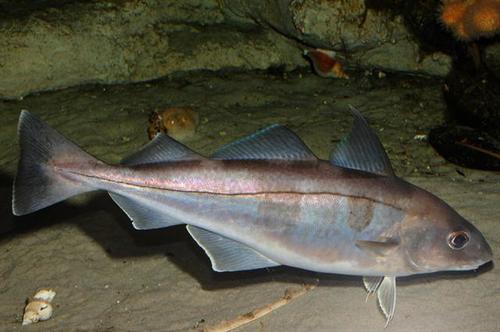
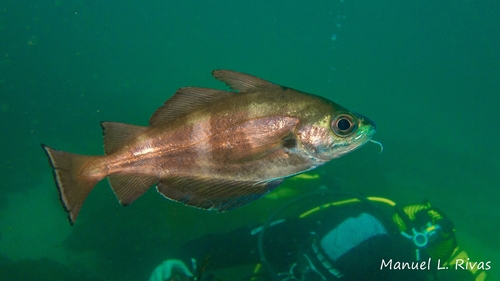
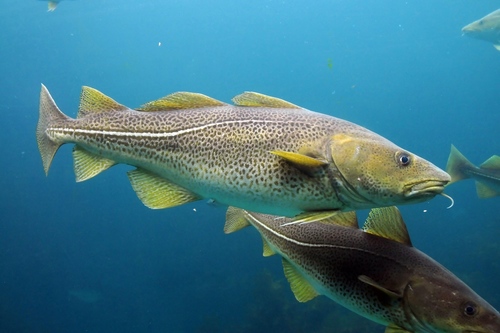
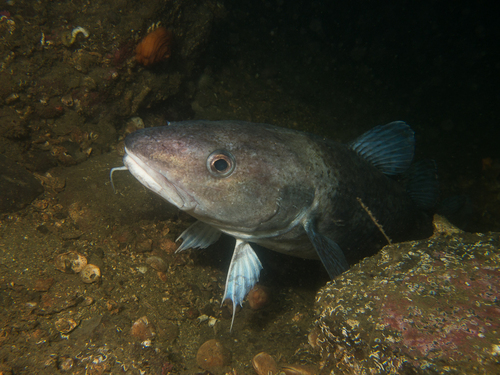
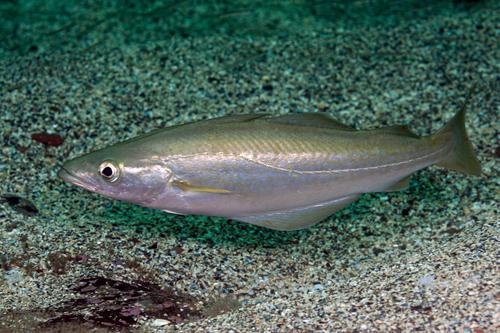
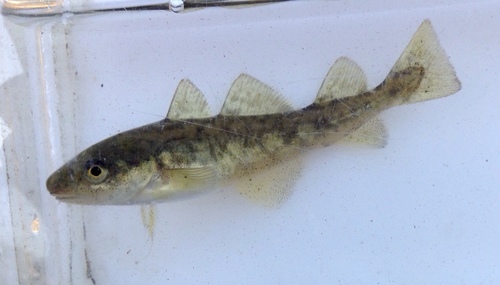
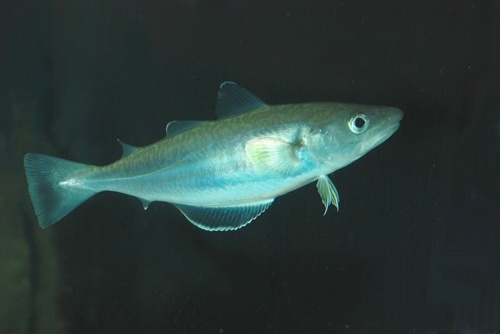
Merlangius merlangus has three dorsal fins with a total of 30 to 40 soft rays, and two anal fins with 30 to 35 soft rays. It has a long body and a small head, and any chin barbel present is very small. This fish can reach a maximum length of around 70 centimetres, or 27 and a half inches. Its base colour may be yellowish-brown, greenish or dark blue; its flanks are yellowish grey or white, and its belly is silvery. A distinctive black blotch is located near the base of each pectoral fin.
Whiting are native to the northeastern Atlantic Ocean. Their range stretches from the southeastern Barents Sea and Iceland to Scandinavia, the Baltic Sea, the North Sea, Portugal, the Black Sea, the Aegean Sea, the Adriatic Sea, and parts of the Mediterranean Sea. They live on sand, mud and gravel seabeds at depths down to about 100 metres, or 300 feet, or 50 fathoms. In 2014, the conservation status of whiting was classified as vulnerable in the Baltic Sea.
Until the late 20th century, whiting was a cheap fish, considered food for poor people or for pets. Whiting can be damaged during industrial trawling and gutting processes, which may remove the sheen from its scales or damage its delicate flesh; angling outside of the spawning season is preferred to preserve these qualities. In France, fried whiting (called merlan locally) is traditionally served with its tail placed in its mouth, on a bed of fried parsley, and this dish is called merlan en colère, or 'angry whiting'. Historically, French wigmakers were called merlan because the flour used to prepare whiting resembled the powder used on wigs. Several other edible fish species from different groups have also been given the common name whiting, including multiple species in the drum, or croaker, family (Sciaenidae), such as the northern kingfish (Menticirrhus saxatilis).