About Meristogenys jerboa (Günther, 1872)
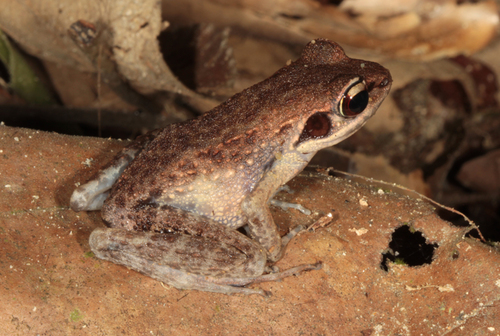
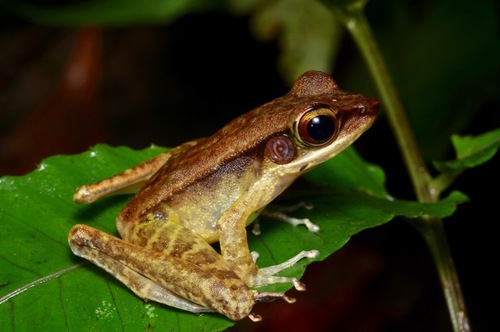
This species, scientifically named Meristogenys jerboa (Günther, 1872), shows strong sexual size dimorphism. Females can reach a maximum snout-vent length of 82 mm (3.2 in), while males are considerably smaller. In a sample across multiple populations containing 32 adult males and 6 adult females, adult males had a snout-vent length of 34–41 mm (1.3–1.6 in) and adult females had a snout-vent length of 61–65 mm (2.4–2.6 in). In vertical view, the snout is protruding. Males have a larger tympanum than females. Males have a slender body shape, while females are slightly more stocky. The toes are webbed. A black marking surrounds the eye and tympanum, and extends onto the flank. The upper third of the iris is bronze, and the lower parts of the iris are coppery. Tadpoles of Meristogenys jerboa have a large suctorial disk. They are generally light brown, but can range in shade from orange to a slightly olive hue. Their snout and body are depressed and streamlined. They have a strong tail with a pointed tip. The largest recorded tadpoles, at Gosner stages 38–41, reach a total length of 41 mm (1.6 in). Meristogenys jerboa lives in rocky streams located in lowland and hillside forests. Breeding occurs along these rocky streams, where tadpoles cling to rocks and likely feed on lithophytic algae. The species' type locality falls within the Matang Forest Reserve, where it is abundant and faces no known threats. When the International Union for Conservation of Nature assessed this species' conservation status in 2004, it was not known to occur outside of this type locality, but later work by Shimada and colleagues has documented the species from multiple additional localities.