About Mergus squamatus Gould, 1864
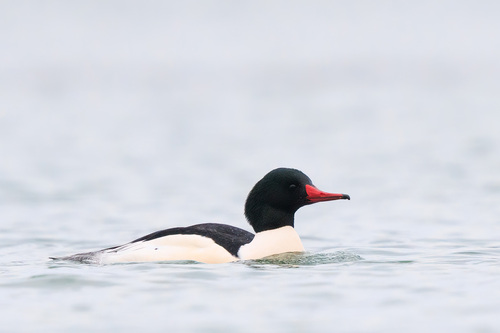
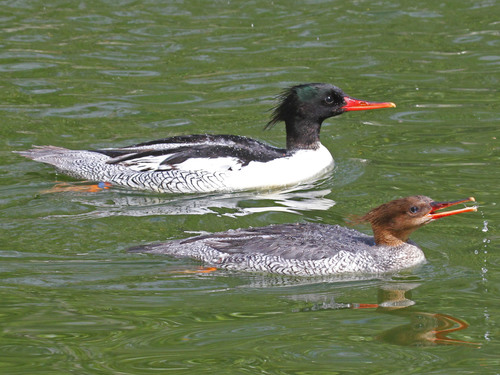
This striking sea duck, Mergus squamatus, has a thin red bill and a scaled dark pattern on its flanks and rump. Individuals of both sexes have a crest of wispy, elongated feathers; in adult males, this crest reaches almost to the shoulders, while it is fairly short in females and immature birds. The adult male has a black head and neck, white breast and underparts, and blackish mantle and wings, with the exception of white inner wings. The scaled pattern is black, and the tail is medium grey. The female has a buffish head, and replaces the male's black coloration with grey overall. In both sexes, the legs are orange-red and the irises are dark brown. Their breeding habitat is rivers in primary forest. Most (85%) of the species' breeding population lives in the southeastern Russian Far East; potential breeding populations also exist in North Korea, and breeding occurs in two locations in northeastern China: the Changbai Mountains and a small isolated location in the Lesser Xingan Mountains. M. squamatus is a migratory species. It winters in central and southern China, with small numbers found in Japan, South Korea, Taiwan, northern Vietnam, Myanmar and Thailand. The birds arrive on their breeding grounds in March, as soon as winter ends, and leave in mid November when the first cold nights arrive. This shy, easily startled species prefers mid-sized rivers that meander through wide expanses of mixed mountain forest, at elevations up to 1,000 meters (3,300 ft) above sea level or lower. Birds tend to move upriver during the day, both when startled and when foraging; this movement likely occurs because stirred-up sediments alert and hide prey downstream. The birds catch food from riverbed gravel using their serrated beaks. They often dive for prey, repeatedly submerging for 15 to 30 seconds with only a few seconds of pause between dives. In shallow water, they only submerge their heads, and do not upend. The birds are not very social during the breeding season, and gather in small groups during autumn and winter. Even on wintering grounds, groups larger than a dozen individuals are very rare. They spend most of daylight hours foraging, except around noon when they rest, preen and socialize on river banks, where they also sleep. The diet of M. squamatus consists of aquatic arthropods, frogs, and small to medium-sized fish. When available, stonefly (Plecoptera) and Phryganeidae giant caddisfly larvae may make up the bulk of its diet. Beetles and crustaceans are eaten less regularly, though crustaceans may be a more important food source in autumn. As aquatic insect larvae hatch through the summer, fish become a more prominent part of the diet. Favorite fish prey include the dojo loach (Misgurnus anguillicaudatus) and the lenok Brachymystax lenok. More rarely eaten species include the lamprey Eudontomyzon morii, the sculpin Mesocottus haitej, and the Arctic grayling (Thymallus arcticus). This species is an opportunistic feeder; for fish, it will generally eat any species that has the right elongated shape and small size. Like typical members of the merganser and goldeneye sea duck lineage, scaly-sided mergansers nest in trees. Preferred nesting tree species include daimyo oak (Quercus dentata), Chozenia, linden, and Ussuri poplar (Populus ussuriensis, a balsam poplar). The species will readily breed in artificial nest boxes placed along rivers with deforested banks. It is sympatric with Mandarin ducks (Aix galericulata), and the two species may compete for nesting holes, which neither species can excavate on its own. In its winter quarters, the scaly-sided merganser may compete with other Merginae that share its winter habitat, such as common mergansers (M. merganser) and common goldeneyes (Bucephala clangula).