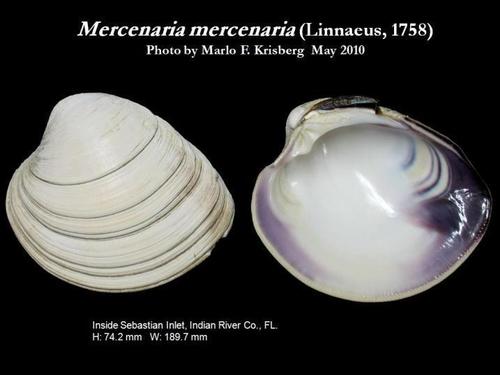
About Mercenaria mercenaria (Linnaeus, 1758)
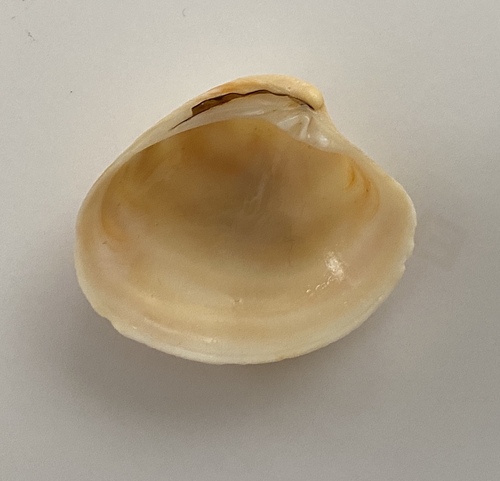
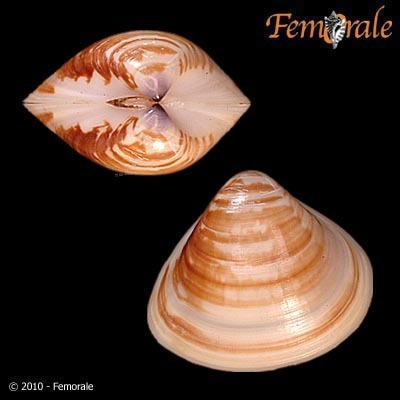
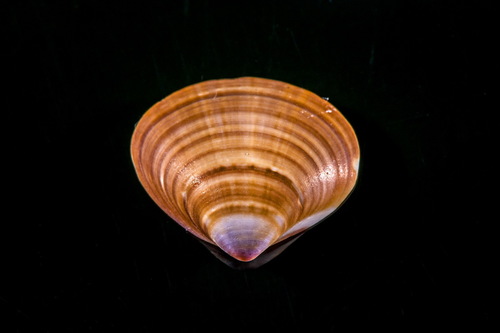
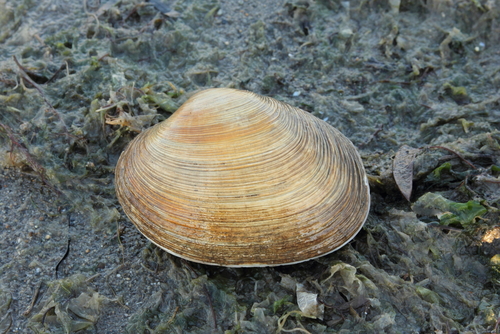
Mercenaria mercenaria, commonly called the hard clam, round clam, hard-shell (or hard-shelled) clam, or quahog, is an edible marine bivalve mollusk. It is native to the eastern shores of North America and Central America, ranging from Prince Edward Island to the Yucatán Peninsula. In the United States, it is one of many unrelated edible bivalves that people often call simply "clams". Older literature sources refer to this species by the systematic name Venus mercenaria. It belongs to the family Veneridae, the venus clams. It is easily confused with the ocean quahog, which is a different species called Arctica islandica. Although ocean quahogs are superficially similar in shape to hard clams, they belong to a different bivalve family, are rounder than hard clams, usually have a black periostracum, and have no pallial sinus on the interior of the shell. This species is native to the Western Atlantic Ocean. It is common throughout New England, extending north into Canada, and all along the eastern seaboard of the United States down to Florida. It is particularly abundant between Cape Cod and New Jersey, where seeding and harvesting of hard clams forms an important commercial aquaculture industry. It is an important part of the suspension-feeding benthic fauna of the lower Chesapeake Bay. Rhode Island lies in the center of "quahog country" and supplies a quarter of the United States' total annual commercial quahog catch. The quahog is the official shellfish of the U.S. state of Rhode Island, and it is the namesake of the fictional Rhode Island town featured in the animated sitcom Family Guy. This species has been introduced and is farmed on the Pacific coast of North America, and in Great Britain and continental Europe. Hard clams reproduce sexually: females and males shed gametes directly into the water. Hard clams live in shallow water; they can be found intertidally on sand flats at low tide. They are spread throughout the South Atlantic Region, and can be found at depths of 15 meters or more. For human use, in coastal areas of the New England states, Long Island, and New Jersey, raw bars or clam bars specialize in serving littleneck and topneck hard clams raw on the opened half shell, usually with cocktail sauce mixed with horseradish, and often with lemon. Littlenecks are sometimes steamed and dipped in butter, though this preparation is less common than it is for the related soft-shelled steamer clam. Littlenecks are often served in-the-shell in sauces, soups, stews, and clams casino, or substituted for European varieties such as the cockle in southern European seafood dishes. The largest hard clams are called quahogs, chowders, or cherrystones; they have the toughest meat, and are used in dishes like clam chowder, clam cakes, and stuffed clams, or minced and mixed into dishes that also use smaller, more tender clams. Historically, Native Americans used quahog shells to make wampum, shell beads that were exchanged in the North American fur trade. The Narragansett people used hard clams for food and to make ornaments. A self-sustaining wild population of hard clams exists in Southampton Water in Hampshire, England. This population originated from clams originally bred in the warm water outflows of Southampton Power Station, intended for use as eel bait. The population became established and self-sustaining, and can now be found throughout Southampton Water, and has also spread to Portsmouth Harbour and Langstone Harbour.