About Menura novaehollandiae Latham, 1802
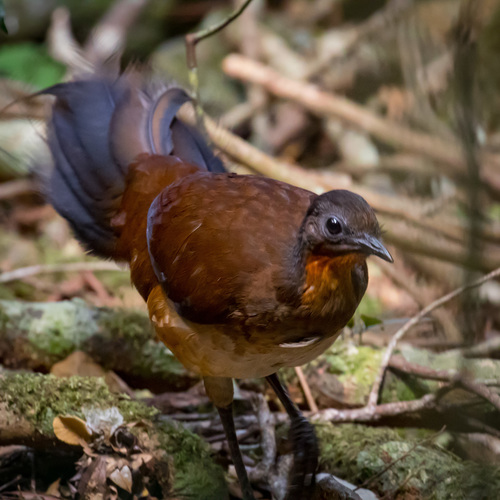
The superb lyrebird (Menura novaehollandiae Latham, 1802) is a large terrestrial passerine roughly the size of a pheasant. Females range from 860 mm (34 in) in length, weigh around 0.9 kg (2.0 lb), while males reach 1 m (39 in) in length and weigh around 1.1 kg (2.4 lb). Its upper body plumage is mostly dark brown, with greyish-brown underparts and red-tinged flight feathers, and it has brighter tail feathers than Albert's lyrebirds. Its wings are short and round, only capable of weak flight; the wings are mainly used for balance, or for gliding from trees down to the ground. It has powerful legs that let it run quickly, and strong feet that can move branches up to 10 cm in diameter. Lyrebirds are ancient Australian animals. The Australian Museum holds lyrebird fossils that date back to around 15 million years ago, and the prehistoric species Menura tyawanoides has been described from early Miocene fossils found at the well-known Riversleigh site. The superb lyrebird is native to forests of southeastern Australia, with a range extending from southern Victoria to southeastern Queensland. This species was introduced to southern Tasmania between 1934 and 1954, a response to unfounded concerns that the mainland population was at risk of extinction. The introduced Tasmanian population is now thriving and growing. Across the rest of the species' large range, superb lyrebirds are common, and the species is classified as Least Concern on the IUCN Red List of Threatened Species. The superb lyrebird's range covers a variety of biomes, including subtropical and temperate rainforest, and both wet and dry sclerophyll forest. The species prefers wet forest and rainforest habitats that have an open ground layer of moist leaf litter shaded by overhead vegetation. In favorable seasons, superb lyrebirds often expand their range into drier areas located further from water sources. Superb lyrebirds are ground-dwelling birds that generally live solitary lives. Adult superb lyrebirds usually occupy individual territories alone, while young birds that do not yet hold territories may gather in small single-sex or mixed-sex groups. Because they are not strong fliers, superb lyrebirds are not highly mobile, and many stay within the same area for their entire lifespan. Superb lyrebird territories are generally small, and documented behavioural differences exist between different populations of the species.