About Menura alberti Bonaparte, 1850
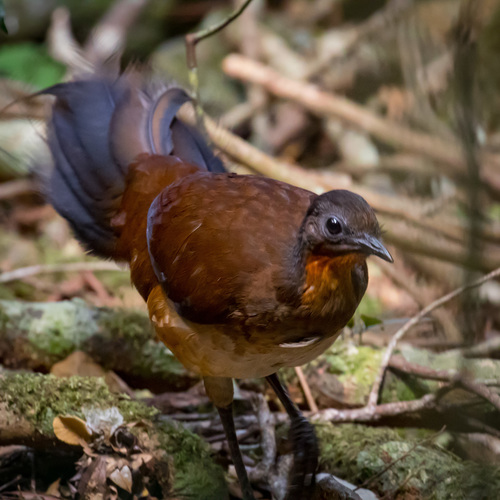
Albert's lyrebird (Menura alberti Bonaparte, 1850) is a ground-dwelling bird. Females reach approximately 75 cm (30 in) in length, while males grow to around 90 cm (35 in). Their wingspan measures 76–79 cm (30–31 in), and they weigh approximately 930 g (33 oz). They are chestnut-brown overall, with rufous coloring on the undertail, rump, and throat. They have a black bill, a dark brown or black iris, and a broad blue-grey ring around the eye. Their legs and feet range from brownish grey to dark grey or black. The sexes are similar in appearance except for tail shape. The male has a spectacular tail made of three distinct feather groups: a central pair of long, ribbon-like dark-brown median plumes; six pairs of long, filmy, luxuriant filamentary feathers that are black-brown above and dark grey below; and a long, broad, fully webbed outermost pair of lyrates that are also black-brown above and dark grey below. The female's tail is shorter, simpler, slightly drooping, and appears more pointed when closed. It consists of a pair of long, narrow, tapered median plumes and fully webbed, broad brown feathers with rounded tips, and lacks filamentaries. When walking, the male carries his tail in an upward-curving train. Juveniles can be distinguished from adults at close range, and are similar to adult females. They can be told apart by four key traits: richer, more uniform rufous-brown coloring on the chin, throat, and foreneck, plus a brighter red-brown wash on the forehead and forecrown; a slightly paler upperbody; softer, downy texture on the rump, lower belly, and vent feathers; and most importantly, tail feathers (excluding the central median pair) that are distinctly narrower, more tapered, and more pointed. After European settlement, the distribution of Albert's lyrebird has declined significantly. Much of the species' habitat was cleared during the 19th century. While the species remained widespread across lowland areas at the start of the 20th century, continued habitat clearing has since pushed most populations into higher altitude forests, usually located at least 300 metres above sea level. In the past, Albert's lyrebirds were shot for meat to be used in pies, to supply tail feathers to globe-trotting curio hunters, or by vandals. In 2000, the total population was estimated at only 3,500 breeding birds, and the species has one of the smallest distribution ranges of any bird on the Australian continent. Today, the species' distribution is limited to several small areas of mountain ranges near far south-east Queensland and far north-east New South Wales, with most remaining habitat located in reserves. In Queensland, Albert's lyrebird occurs from Tamborine Mountain and Springbrook National Park in the east, to the McPherson Range in the west. Isolated populations are found in Mount Barney National Park and on the Main Range, and the largest single population lives on the Lamington Plateau. The species was previously recorded in the Sunshine Coast hinterland and the D'Aguilar Ranges, but has since disappeared from these areas. In New South Wales, it is only found in the far north of the Northern Rivers region, along the Border Ranges and in Nightcap National Park in the east, and possibly extends as far west as Koreelah National Park. A large concentration lives in the Mount Warning area, and isolated populations may still exist in remnant rainforest patches as far south as Wardell. Albert's lyrebird prefers rainforest with a dense understorey of vines and shrubs, or wet sclerophyll forest with a dense understorey of rainforest plants, including temperate rainforest. It is occasionally found in areas of mixed eucalypt forest with a mesic understorey, located around gullies and lower slopes, that includes small patches of rainforest in wet gullies. The specific composition of plant species in these forests does not appear to matter, except that forests with a eucalypt canopy always support higher population densities than eucalypt-free rainforests at sites with equivalent climates. Population densities increase along a gradient of increasing rainfall and decreasing mean annual temperature. As moisture index decreases, male density declines, and individuals become increasingly restricted to areas around gullies. When comparing wet sclerophyll forest and rainforest with matching climate and moisture index, higher densities always occur in wet sclerophyll forest, a pattern associated with greater masses of litter and logs and slower litter decomposition rates. Steep moist valleys and areas protected from wildfire by physical or geographic features likely serve as important refuge habitat. Albert's lyrebird usually occurs singly or in pairs, and rarely in groups of three. It is sedentary (non-migratory) and stays in the same general area year-round. Males are territorial during the breeding season. Females appear to hold their own separate territories that partially overlap male territories, and they defend these areas as feeding grounds rather than mating centers. Data on territory size is only available for males, whose territories typically cover 5–15 ha (12–37 acres). The mating system of Albert's lyrebird remains unknown, though the male courtship display is well documented. Males clear debris from a flat patch of ground to use as a display stage, unlike the superb lyrebird which uses a mound of debris. During display, the male first raises his tail to arch forwards over his head, then gradually lowers and shimmers it forwards until he is enveloped beneath a veil of fine bushy filaments, which appear silvery when the shiny white underside of the plumes is turned uppermost. There is no evidence of a lasting pair bond between males and females. Across the species' range, eggs have been recorded from late May to mid-August. Nests are built beneath the forest canopy, usually in the darkest parts of the forest. Nests are often located in rocky areas, typically on ledges, in clefts, between rocks, or occasionally in caves, on rock or cliff faces, or in deep rocky ravines; nests in these locations are sometimes found near waterfalls. Nests may also be placed in a variety of other sites: on the ground on steep slopes, on creek banks, between the buttress roots of fig (Ficus) trees, amongst tree stumps, at the base of palm trees, amongst ferns, in dense shrubs, or occasionally in tree forks. Females sometimes nest close to sites used the previous year, and occasionally re-use nest sites. Only the female builds the dome-shaped nest, which has a side entrance. The nest is constructed from sticks, fern fronds, rootlets, bark, pieces of palm leaf, and moss, and lined with moss, fine plant material, and feathers. Nest construction takes at least three weeks. The nest looks like a natural pile of accumulated rainforest debris, making it quite inconspicuous. The clutch size is always a single egg. Eggs can vary greatly in color and sometimes in shape, but are usually shaded brown or grey with spots, blotches, and sometimes other markings in varying tones of brown and grey. The female handles incubation, feeding, and brooding of nestlings with no assistance from the male. Young birds fledge at approximately five and a half weeks. No data is available on breeding success, but it is thought that a maximum of one brood can be raised per breeding season.


