About Mentzelia involucrata S.Watson
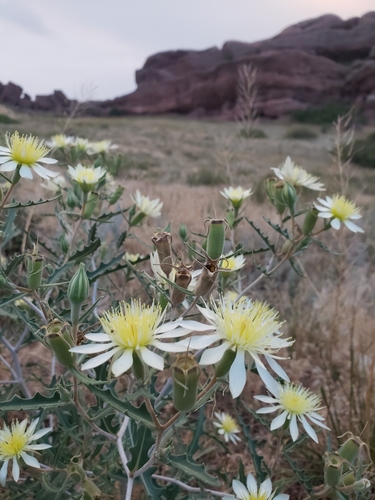
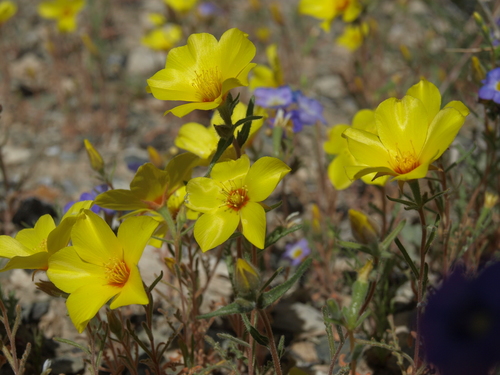
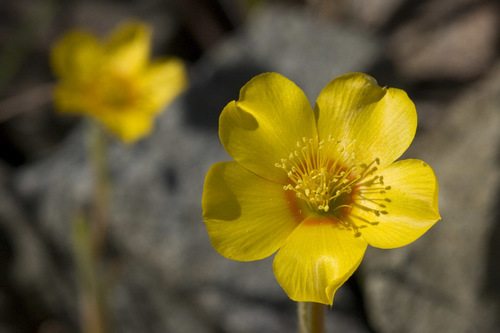
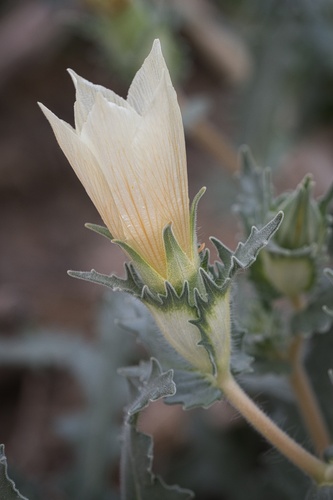
Mentzelia involucrata S.Watson is an annual plant that reaches a height of 3 to 32 cm. It grows larger leaves arranged in a basal rosette, and produces smaller leaves along its stem. The leaves measure between 2 and 18 cm long, have irregularly toothed margins, are sessile, and range in shape from lanceolate to elliptic. Its flowers are usually borne singly, and are subtended by 4 to 5 bracts. The flowers have five sepals 7–23 mm long and five cream-yellow petals 13–62 mm long. The fruit is 14–22 mm long and 5–10 mm wide, and contains rough ash-white seeds that are 1–3 cm long. A distinctive trait of this species is its bracts, which are almost entirely white with a green border. This species is notable because it is part of a pollinator competition that has resulted in mimicry. It produces nectar to attract bees of the genus Xeralictus. In areas where their ranges overlap, Mohavea confertiflora (Ghost Flower), a species that does not produce nectar, has evolved a form that resembles Mentzelia involucrata. Recent studies have suggested that in addition to mimicking M. involucrata, Mohavea confertiflora flowers have marks that look like female Xeralictus. This mimicry attracts male bees that would otherwise ignore the flowers. The natural habitat of Mentzelia involucrata consists of open, rocky or sandy areas with creosote-bush scrubs, as well as washes, alluvial fans, and steep slopes. It is typically found at elevations between 50 meters and just below 900 meters.