About Mentzelia decapetala (Pursh) Urb. & Gilg
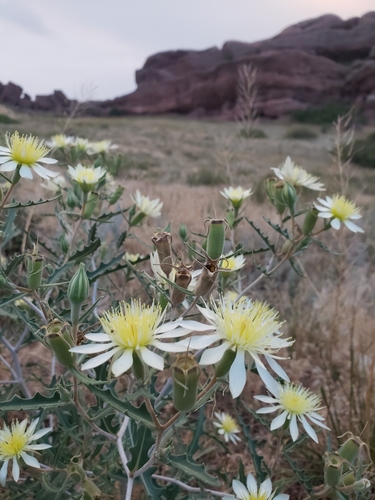
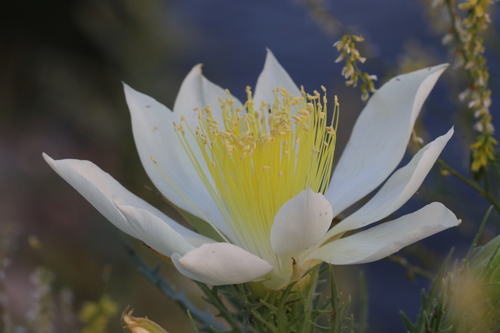
Tenpetal blazingstar (Mentzelia decapetala) is most often a bush-like perennial or biennial plant. Very rarely, individuals may grow as annuals, blooming late in their first year before dying immediately, or delay flowering into a second year due to unfavorable weather or damage, remaining immature through the first growing season. Plant height is variable, usually ranging from 15 to 91 centimeters (6 to 36 inches) tall, and may occasionally reach up to 100 cm (39 in). Plants typically grow with a single upright straight stem, though they may occasionally produce multiple stems. Stems are covered in thin white peeling bark, are covered in hairs, and may branch only at their tips or along their entire length. This species grows a deep taproot and is tolerant of drought. Mature leaf blades range from 7.2 to 29.5 cm (2.8 to 11.6 in) long and 1.4 to 4.5 cm (0.6 to 1.8 in) wide. Leaf edges have coarse, irregular serrations, and leaf surfaces feel like sandpaper. This rough texture comes from stiff, barbed hairs that allow leaves to stick very tenaciously to clothing or animal fur; when viewed under a microscope, these hairs have a shape similar to a Japanese pagoda. In its first year of growth, tenpetal blazingstar produces a basal rosette of leaves that measure 10 to 20 cm (3.9 to 7.9 in) long and 1 to 3.5 cm (0.39 to 1.38 in) wide. First year leaves are oblong to oblanceolate, meaning they are somewhat rectangular with rounded corners, or shaped like a reversed spear head with the point facing the stem and the widest portion beyond the leaf midpoint. The edges of these leaves are toothed, with rounded indentations between more pointed lobes. Leaves growing lower on stems are oblanceolate or elliptic, with two gentle curved sides and the widest portion at the midpoint between the leaf tip and base. Each lower stem leaf has 16 to 26 antrorse teeth or lobes that curve slightly upwards. Leaves growing near stem tips are elliptic to lanceolate; lanceolate leaves are shaped like a spear head, with the widest portion below the leaf midpoint. The base of upper stem leaves may wrap around (clasp) the stem. Tenpetal blazingstar is native to a large portion of the Great Plains, ranging from northern Texas north to southern Canada, from Alberta east to Manitoba. In Alberta, it only grows in the southern quarter of the province. The USDA Natural Resources Conservation Service PLANTS database records the species across most of Montana, in parts of western North Dakota, and scattered throughout South Dakota in the northern Great Plains. The PLANTS database also reports the species from Butte County, Idaho, but Plants of the World Online and the Flora of North America (FNA) do not list it as native to Idaho. Neither of these two sources report the species as present in Nevada or North Dakota. Further south on the Great Plains, the species grows across much of Wyoming, scattered through Nebraska, along the western edge of Iowa, in western Kansas, and in eastern Colorado. It can also be found in the northeast corner of New Mexico, the Texas panhandle, and western Oklahoma. In Utah, it is only recorded from Cache County in the northern part of the state. The population found in Grundy County, Illinois is generally agreed to be an introduced population. This species prefers disturbed ground such as roadsides. It can grow in rocky, sandy, or somewhat clay soils, and may also be found on dry hillsides with high lime content in tallgrass prairie. It does not compete well with other plant species, so it is generally found in areas with sparse vegetation such as shale outcrops. It also tolerates higher salt levels in soil. The iridoid glycoside mentzeloside was first isolated and identified from tenpetal blazingstar in 1968. When purified, this chemical is a white crystalline solid, and it is found in the plant's flowers and seed pods. While working to more precisely characterize mentzeloside, a second iridoid called decaloside was isolated from the species in 1973. Tenpetal blazingstar plants accumulate selenium from selenium-containing soils, which makes them mildly poisonous. The larvae of the moth Anoncia leucoritis feed on the plant's seed pods, and this moth is in turn parasitized by the wasp Bracon mellitor. The bee Perdita wootonae is an oligolectic species, meaning it narrowly specializes in collecting pollen from very few plant species. These bees visit tenpetal blazingstar flowers in the late afternoon as soon as they open. However, when bees climb out onto the long stamens to collect pollen, they do not transfer any pollen to the flower's stigma, providing no benefit to the plant. Though P. wootonae is not a pollinator of this species, tenpetal blazingstar is primarily cross-pollinated by other bee species, with some visitation and pollination by nocturnal sphinx moths. In South Dakota, the moth Sphinx vashti has been observed visiting the flowers. When pollinators are not available, tenpetal blazingstar can produce seeds through self-pollination. Greenhouse studies of the species found that plants develop full seed capsules even when isolated from insect pollinators. Loose pollen released when the flower opens is deposited on the flower's reproductive parts when the bloom closes for the day. Flowers close during the day as an adaptation to avoid water loss in dry environments. Seeds are primarily distributed by wind. Seed capsules are held upright, and seeds are only flung out on windy days by the swinging movement of stiff, dry stems. Tenpetal blazingstar is grown as a garden ornamental for its large, showy, fragrant flowers, and is particularly used in moon gardens or along roadways. It requires full sun and well-drained soil. Extended periods of waterlogging will kill plants at any growth stage. Due to its very long, fibrous taproot, the plant is difficult to transplant, and is most often directly seeded into its desired garden location. The taproot will grow to 15 cm (6 in) deep before the above-ground portion of the plant reaches 2.5 cm (1 in) tall. Seeds require one month of cool, moist stratification for good germination. It is winter hardy in USDA Zones 4–9.