About Menticirrhus undulatus (Girard, 1854)
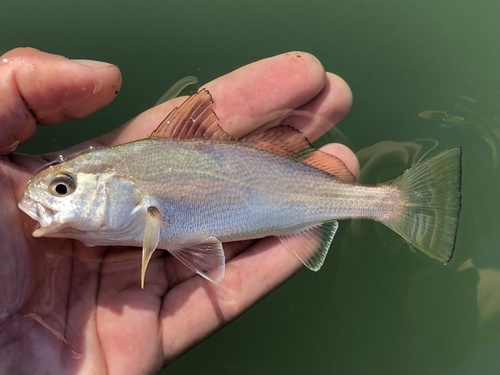
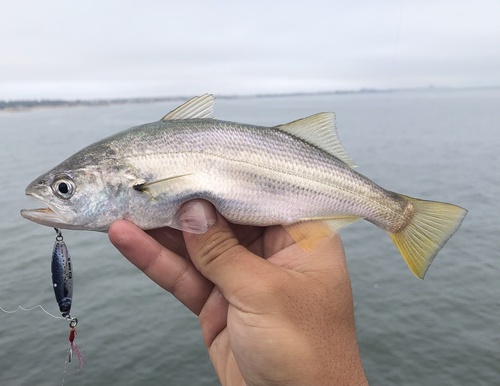
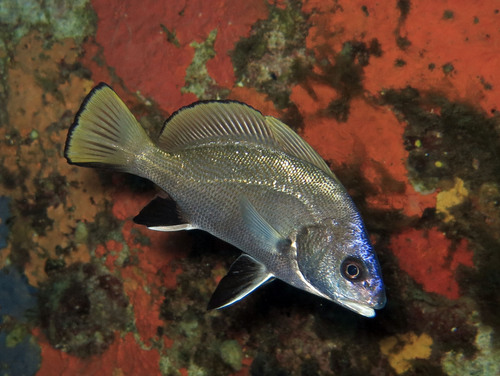
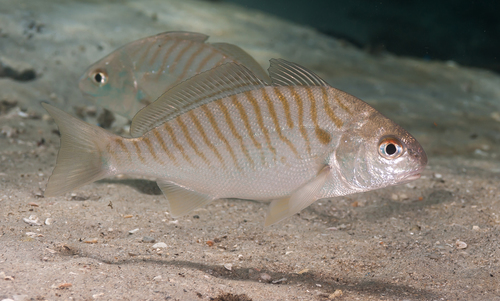
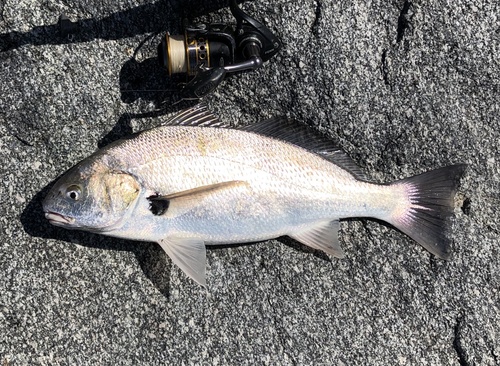
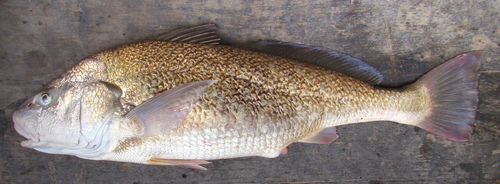
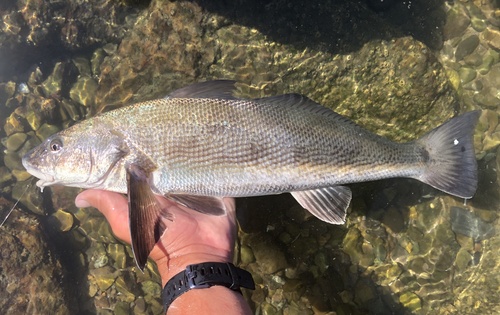
California corbina (Menticirrhus undulatus) have a uniformly grey color with some iridescence. Compared to other croakers, they have an elongated and slightly compressed body shape. Like all members of the genus Menticirrhus, California corbina lack a swim bladder, but are still able to produce a croaking sound. Researchers believe the loss of the swim bladder evolved to help this species survive in a turbulent environment. Out of the eight coastal croaker species found in California waters, only this species and the yellowfin croaker have a single barbel on the lower jaw. The California corbina’s barbel is short and stiff, and it is used to detect prey. The trailing edge of the upper half of the caudal fin is concave, while the trailing edge of the lower half is convex. The largest recorded California corbina specimen measured 28 inches (710 mm) and weighed 8.5 pounds. California corbina are reported to occur from the Gulf of California, Mexico, to Point Conception, California. However, the IUCN questions the accuracy of the species’ reported southern range extent, because similar, easily misidentified species live in the Gulf of California. This species is most commonly found in shallow troughs and ditches that run parallel to sandy beaches, as well as in shallow bays, at depths up to 20 meters (66 ft). They are often found in small groups, though adult individuals have also been observed traveling alone. California corbina move through the shallow waters of sandy beaches to search for food, and seek shelter beneath the rough white water created by waves. Male California corbina reach maturity at approximately 2 years of age and around 10 inches in length, while females reach maturity at 3 years of age and around 13 inches in length. Spawning occurs from June to September, with the peak spawning period falling in July and August. The eggs of this species are free floating. Current data on the population size, recruitment, and mortality of this species is unknown.