About Mentha pulegium L.
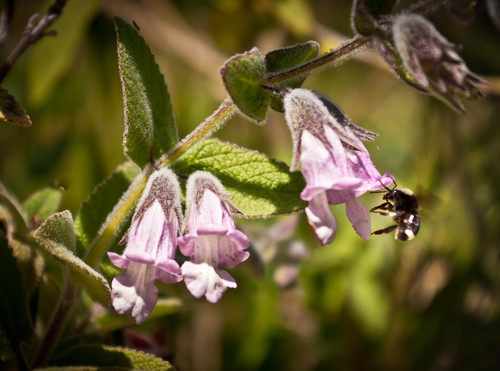
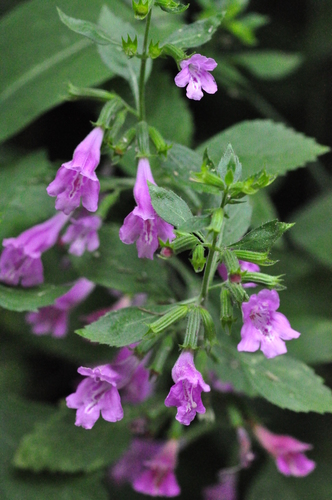
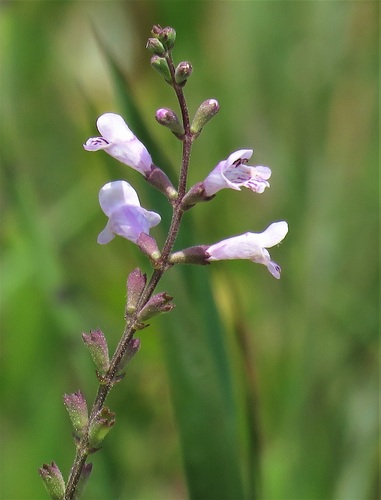
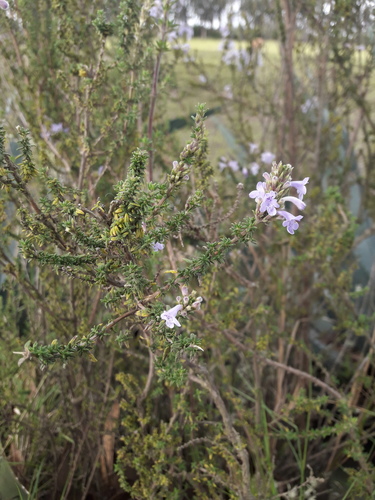
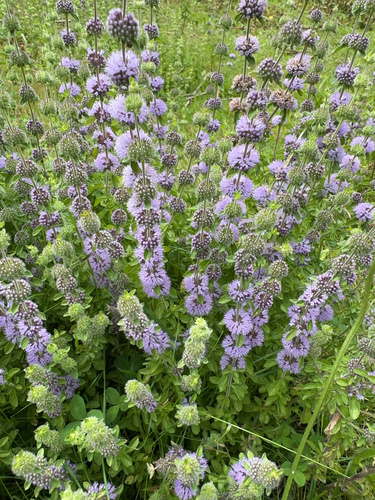
Mentha pulegium L., commonly known as pennyroyal, is an annual to perennial plant with creeping or erect branched stems that grow to around 40 cm tall. Stems are square in cross-section, range in color from green to sometimes red or purple, and may be hairless or densely hairy. Its leaves grow in opposite pairs; they are narrowly oval, 2–3 cm long by 1 cm wide, downy, sparsely toothed near the tip, and taper to a short stalk. All parts of the plant give off a strong scent when crushed, but it has no noticeable surface glands. Small, 6 mm flowers are densely packed into widely separated whorls at stem nodes, sitting above pairs of leaf-like bracts. The calyx is a ribbed tube about 3 mm long with five triangular teeth, where the lower two are narrower and slightly longer than the upper three; it is hairy on both the inside and outside. The corolla has four mauve lobes (or petals) and is hairy only on the outside. Flowers are bisexual and have four long stamens, of which two or all four extend well beyond the corolla lobes. There is one long style that is forked into two stigmas, which also project out from the flower. The fruit is a cluster of four brown, 1-seeded nutlets, each around 0.7 mm long. Flowering begins in June and continues into mid-summer; in northern countries it starts much later, sometimes as late as September, and may fail to set seed when it flowers this late. Its chromosome number is 2n = 20.
Pennyroyal is thought to be native to the eastern Mediterranean, where it grows in damp meadows, around pools, and along stream margins. It has become very widely established across the globe, including in North and South America, throughout Africa, Asia, Australia, and New Zealand. It is considered a troublesome agricultural weed in many regions. Near the northern edge of its range, such as in Britain, it is rare and declining, except where it has been introduced.
Pennyroyal’s typical habitat is seasonally damp pasture, where winter standing water leaves bare ground in summer, and livestock preferentially graze other plant species. A similar habitat occurs on roadsides, where trampling or ground disturbance creates comparable bare soil, especially in areas that waterlog in winter. It can also be found along watercourses, in wet woodland, and in abandoned fields. In California, where it is classed as an invasive species, it occupies the same type of niche in seeps, streamsides, vernal pools and swales, marshes, and ditches, and there is some speculation that it may displace native species in these habitats. Few animals eat pennyroyal. In Britain, the only insect known to feed on it is the seed bug Heterogaster artemisiae Schilling, which normally feeds on wild thyme. It is considered an axiophyte in many British counties, because the low-intensity pasture it favors is a rare habitat, though it has been spreading in recent decades. Its Ellenberg values in Britain are L = 8, F = 7, R = 5, N = 7, and S = 0.
Pennyroyal is toxic to humans, and its effects depend on the volume and concentration ingested. The most concentrated and toxic form is pennyroyal oil, which contains pulegone, a cyclohexanone that makes up 80–92% of the plant’s total composition. Pulegone causes a range of health problems in people who ingest it, and it is also the compound that gives the plant its peppermint flavor. After ingestion of a small dose (less than 10 mL) of pennyroyal oil, symptoms including nausea, vomiting, abdominal pain, and dizziness may persist. Larger volumes can cause multiorgan failure that may lead to death. No toxicokinetics studies on the effects of pulegone in humans have been conducted to date, though some studies have been done in other mammals. When ingested, pulegone is broken down by the liver and reacts to form multiple toxic metabolites that damage bodily systems. Identified metabolites include menthofuran, piperitenone, piperitone, and menthone. Ingestion of as little as 10 mL of pennyroyal oil has been linked to moderate to severe hepatic toxicity.
Documented use of pennyroyal goes back to ancient Greek, Roman, and Medieval cultures. Its name, of uncertain etymology, is linked to the Latin word pulex meaning flea, a reference to its historical use smeared on the body to repel fleas. Greeks and Romans commonly used pennyroyal as a cooking herb; many recipes in the Roman cookbook of Apicius call for pennyroyal, often alongside herbs like lovage, oregano, and coriander. While it was also commonly used for cooking in the Middle Ages, it gradually fell out of use as a culinary herb and is rarely used this way today. Greek and Roman physicians and scholars recorded pennyroyal’s medicinal properties and preparation recipes. Pliny the Elder described the plant as an emmenagogue that could also expel a dead fetus in his encyclopedia Naturalis Historia. Galen and Oribasius only listed pennyroyal as an emmenagogue, but Roman and Greek writers Quintus Serenus Sammonicus and Aspasia the Physician both agreed that pennyroyal served in tepid water was an effective abortive method. A gynecological medical text attributed to Cleopatra, actually written by female Greek physician Metrodora, recommends using pennyroyal with wine to induce abortions. Aristophanes referenced its contraceptive properties jokingly in his 421 BCE play Peace, when the god Hermes reassures the main character Trygaios that a dose of pennyroyal would resolve any accidental pregnancy. In Aristophanes’ comedy Lysistrata, a slender female character is compared to a pregnant character and described as a lovely, well-tended land trimmed and spruced with pennyroyal. Early colonial Virginia settlers used dried pennyroyal to eradicate pests. Pennyroyal was so popular that the Royal Society published an article on its use against rattlesnakes in the first volume of its Philosophical Transactions in 1665. 17th-century apothecary and physician Nicholas Culpeper mentions pennyroyal in his 1652 medical text The English Physitian; in addition to noting its abortive properties, Culpeper recommends it for gastrointestinal ailments including constipation and hemorrhoids, as well as for skin itching and blemishes, and even toothaches. Pennyroyal remains an essential ingredient in the still-eaten North African dish Batata fliou. It has continued to be used through the 20th and 21st centuries; its oil is still sold commercially, but little is known about appropriate dosages for humans, so scientists generally consider it unsafe for use due to its potential toxicity.
Pennyroyal is often used as an insecticide and pest repellent. It is used to keep fleas away from household pets, and to repel gnats and mosquitos on humans. Some pet flea collars include pennyroyal oil, or crushed herb can be added to collar linings. Humans also tuck crushed pennyroyal stems into pockets or on clothing to repel unwanted insects. However, concentrated pennyroyal oil should be avoided for this use, as it can be extremely toxic to both humans and animals even in small quantities. When using pennyroyal near people and animals, there is a risk of absorption through the skin that can cause negative health effects, so the less concentrated leaves of the plant should be used instead as an insect repellent. Pennyroyal has also historically been used as a mint flavoring in herbal teas and foods. It is recommended that pennyroyal tea not be drunk regularly, and consumption of pennyroyal tea can be fatal to infants and children. In Italy, fresh leaves of this species, called menta romana in Rome and the surrounding area, are used in Roman cuisine to flavor lamb and tripe. In culinary use, it should not be confused with lesser calamint (Clinopodium nepeta), which is used in Rome to prepare artichokes. Pennyroyal has also been used as an emmenagogue and an abortifacient. Rennie’s 1833 supplement to pharmacopeias listed it as an expectorant, diuretic, and emmenagogue when used in doses of 0.6–1.3g of powdered dried herb, but dismissed the use of Pennyroyal Water (Aqua Pulegii) as an abortifacient as a popular but incorrect belief, with no mention of toxicity. Chemicals in pennyroyal cause the uterine lining to contract, leading to shedding of the uterine lining. Since the U.S. Congress passed the Dietary Supplement Health and Education Act in October 1994, all manufactured forms of pennyroyal sold in the United States carry a warning label against use by pregnant women, but pennyroyal is not regulated by the U.S. Food and Drug Administration. At least one study has found that pennyroyal oil has potent acaricidal activity against house dust mites.