About Mentha cervina L.
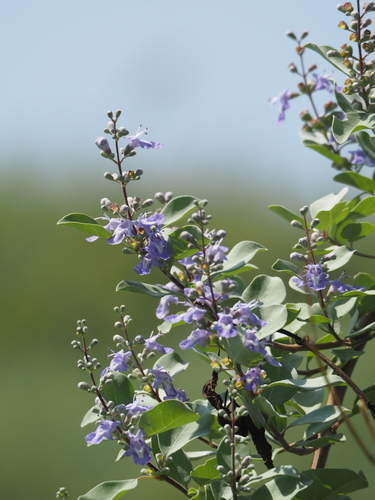
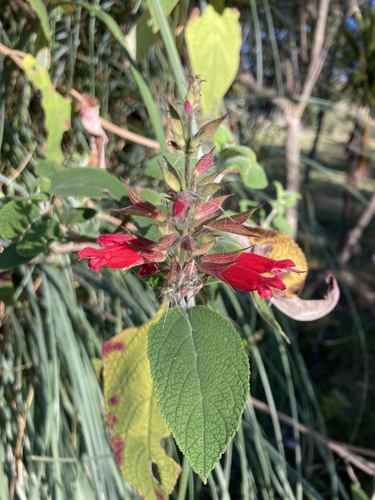
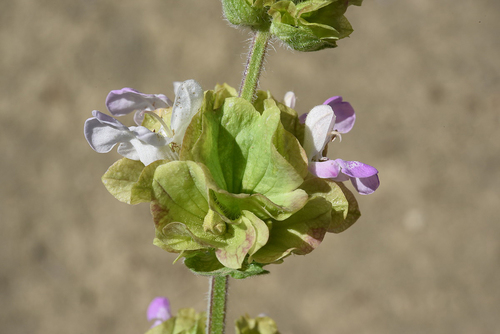
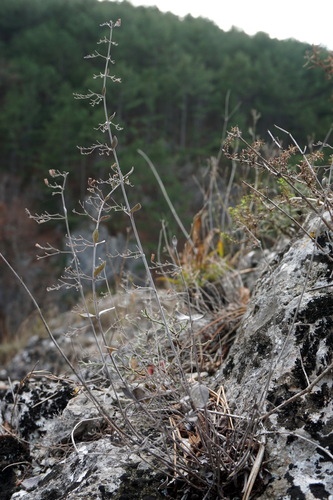
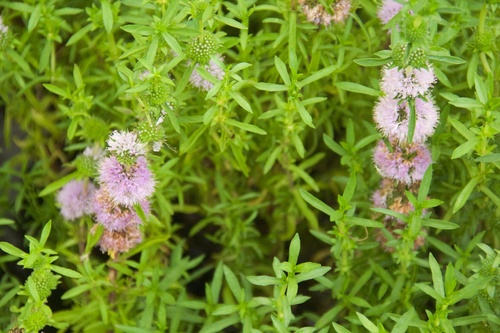
Sources disagree on the height of Mentha cervina, with reports ranging from 30 centimeters to up to two feet tall. This plant has slender, lance-shaped aromatic leaves, and its bracts are palmate, with stamens longer than the corolla. It produces pale blue to lilac flowers arranged in large, dense whorls that hold many flowers. Mentha cervina produces few seeds, so most of its reproduction occurs vegetatively via rhizomes. This species can be distinguished from other species in the Mentha genus by several unique traits. Unlike other Mentha species, which have simple bractales, the bractales of Mentha cervina are digitately lobed. Most Mentha species have five calyx lobes, while Mentha cervina only has four. While most Mentha species have calyx lobes with an acute apex, Mentha cervina instead has whitish apical spines on each calyx lobe; this trait is only shared with Mentha gattefossei. Mentha cervina can also be identified by its fine, small leaves. Phylogenetic studies confirm that this plant has diploid chromosomes. Two separate surveys conducted in the 1970s found a gametic chromosome count of 2n = 36 for Mentha cervina. Chambers and Hummer's analysis of the USDA's Mentha collection agreed with this count. In contrast, Tucker and Naczi's 2006 work suggested a count of 2n = 26. A 2002 study by Bunsawat found a genomic chromosome count of x = 12. While essential oil composition often varies significantly within individual Mentha species, researchers have found particularly chemically homogenous chemotypes among Mentha cervina populations in Portugal. Researchers have noted that both Mentha cervina and Mentha pulegium are major producers of pulegium, and have also reported that Mentha cervina produces more biomass than the more widely cultivated Mentha pulegium. The contemporary native distribution of Mentha cervina is limited to the western Mediterranean region, found in Portugal, Spain, Morocco, Algeria, and six southwestern departments of France. It grows in habitats ranging from damp land to water up to 60 centimeters deep, and overwinters underwater in its native range. It is a central component of the Menthion cervinae plant alliance. According to the International Union for Conservation of Nature, Mentha cervina is experiencing severe and rapid declines across its entire range, so it has been assessed as a Near Threatened species on the IUCN Red List. Its extinction risk is particularly high due to its originally limited habitat range. Its historical Mediterranean range was larger, once extending into Italy and Switzerland. Johann Trommsdorff reported wild Swiss populations of the species in 1809, and Antoine Gouan similarly noted its presence around the mountain lakes of Le Grammont in the canton of Valais. François-Joseph Cazin described the species as formerly growing in the Provence region of France; today, it is limited to just a few areas of Provence, in the departments of Bouches-du-Rhône and Vaucluse. It is presumed to be completely extinct in the wild across all of Italy. Within the Iberian Peninsula, Mentha cervina was formerly recorded in locations including Benavente, Valdemorillo, and Atienza in Spain, and Peso da Régua in Portugal, but it no longer exists at these sites. It has escaped from horticulture and established wild populations in Belgium, where it is considered invasive. In his work Natural History, Pliny the Elder described a plant called "Polyenemon" that had "seed like that of pennyroyal" and a "pleasant though pungent smell". Pierre Desfontaines identified this plant, which was described as being chewed and applied to wounds caused by iron, as Mentha cervina. An 1895 reference for druggists recommended Mentha cervina for its value as both an aromatic and a nauseant. The 1860 edition of Robert Hooper's Lexicon Medicum stated: "This plant possesses the virtues of pennyroyal in a very great degree; but is remarkably unpleasant. It is seldom employed but by the country people, who substitute it for pennyroyal." In Portugal, the whole plant, whether fresh or dried, is added to stews, salads, soups, cheeses, and sauces. There are also recorded recipes using it for liqueur infusions. Within the Alentejo region, it is used both for medicinal purposes and as a seasoning for traditional fish dishes. Purported medicinal uses of Mentha cervina include use as an antiseptic, carminative, febrifuge, and digestive aid, as well as claims of benefits for the respiratory system. Along with Mentha pulegium, it has been traditionally used as a pest repellent. In modern research, the chemical constituents pulegone, menthol, and isomentone from the plant have been reported to possess antioxidant, antibacterial, and antifungal properties.