About Menispermum canadense L.
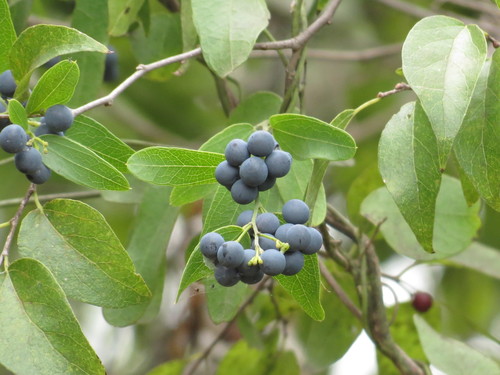
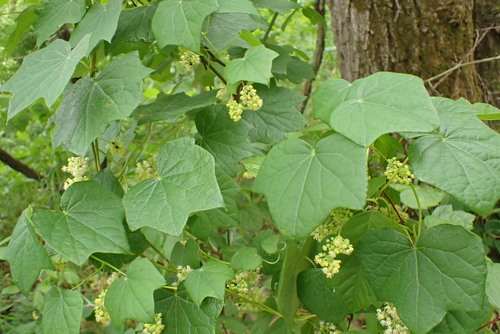
Menispermum canadense L., commonly called Canadian moonseed, is a woody climbing vine that grows up to 6 metres (20 feet) tall. Its leaves are palmately shaped, 5–20 centimetres (2–8 inches) in diameter, and usually have 3–7 shallow lobes; occasionally leaves are rounded and lack lobes entirely. It produces purple-black berries in clusters that measure 6–10 cm (2+1⁄4–4 inches) across, with each individual berry 1–1.5 cm (1⁄3–2⁄3 inches) in diameter. The seed inside each berry resembles a crescent moon, which gives the plant its common name. The fruit ripens between September and October, the same ripening window as wild grapes. Both the leaves and fruit of Canadian moonseed look similar to those of wild grapes, and this similarity can be dangerous because moonseed fruit is poisonous. The plant grows from a rhizome root, so a single individual can form large colonies of genetically identical plants. All parts of Menispermum canadense are poisonous. Its primary toxic compound is the alkaloid dauricine. Consuming the fruit of Canadian moonseed is poisonous and can be fatal. When foraging for wild grapes, people can check fruit seeds to avoid misidentification: moonseeds have one crescent-shaped seed per berry, while wild grapes have round seeds. Scent can also help distinguish the two plants: moonseed has an odor described as "Poodank". Additionally, the moonseed vine does not have tendrils, while wild grape vines have forked tendrils. The Cherokee people used moonseed as a laxative, and as a remedy for gynecological and venereal conditions. Cherokee people used the plant's root to treat skin diseases. The Lenape people used moonseed in a salve to treat skin sores. Americans of European descent have also used this plant for a range of medicinal purposes.