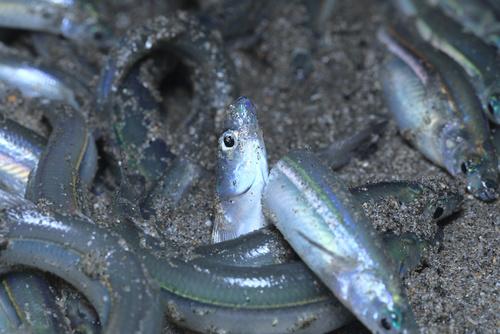
About Menidia beryllina (Cope, 1867)
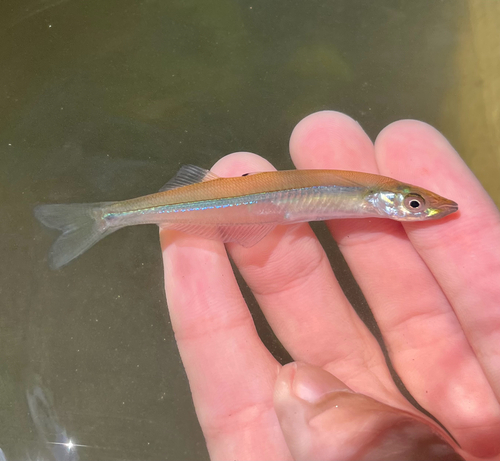
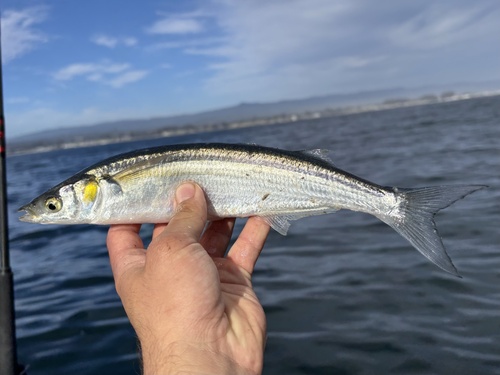
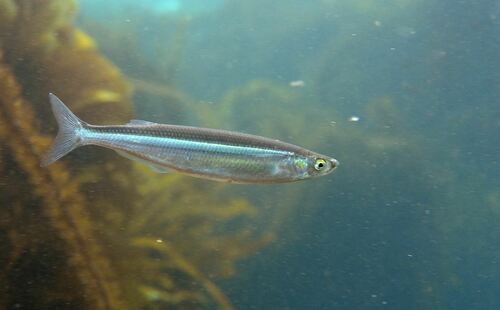
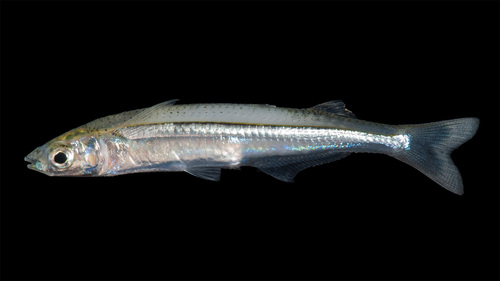
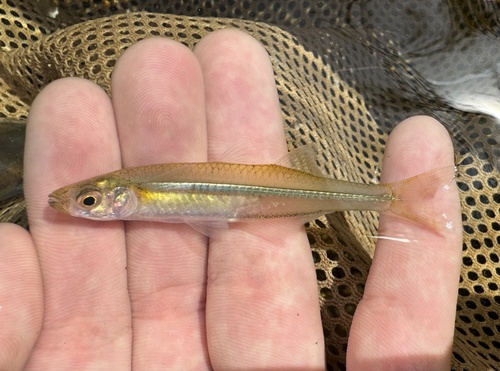
The inland silverside, scientifically known as Menidia beryllina, is a neotropical silverside fish native to eastern North America and introduced to California. It lives in estuaries and freshwater environments. Even among silversides, this species has an especially elongated body, with a total length that is six to seven times its body depth. It has large eyes, a distinctly upturned mouth, and a noticeably flattened top to the head. It has two widely separated dorsal fins: the anterior fin is small, with four to five weak spines, while the posterior fin is larger, with one spine and eight or nine rays. Its long anal fin is slightly sickle-shaped, with one spine and 16 to 18 rays. True to its common name, the sides of this fish are silvery; its back is somewhat yellow, and its underside is translucent green. This is a small fish species: the largest recorded individual measures 15 cm, but most adults are 10 cm or shorter. The inland silverside feeds primarily on zooplankton, and travels in very large schools that can reduce populations of the small arthropods and crustaceans it prefers to eat. In turn, the inland silverside is prey for many species of fish and birds. These fish gather in shallow water, usually over sand or gravel bottoms, preferring locations with overhead cover when available. They move out into open water to find more food, which increases their risk of being preyed on, resulting in a consistent daily migration pattern that is often observed. The exact full native range of the inland silverside is not confirmed, but it is widespread along the Atlantic coast from Maine to Florida, and along the Gulf of Mexico. In the Mississippi River, it occurs in backwaters and reservoirs as far north as Missouri and Illinois, hundreds of miles inland from the coast. It was introduced to Clear Lake and the Blue Lakes of California in 1967 to control the Clear Lake gnat Chaoborus asticopus and midges, and to lakes and reservoirs in Alameda County and Santa Clara County the following year. From these introduction sites, it spread into San Francisco Bay and California’s Central Valley, and has since become widespread in central California. In some areas, it is the most abundant fish species of any present. Peter Moyle has suggested this species may have contributed to the decline of the Clear Lake splittail, though the impact of the inland silverside introduction on California ecosystems has not been extensively studied. The inland silverside is currently an EPA-approved indicator species for acute marine aquatic toxicity testing, and for estimating short-term chronic toxicity in marine and estuarine organisms. Because it is susceptible to stormwater and heavy metal pollution, it is often used to indicate overall watershed health. A study of an introduced population in San Diego, California found that even 5–10% effluent concentration of pollutants can cause abnormal development of inland silverside embryos and larvae. Elevated pollutant levels, most often from stormwater inflow, have been linked to increased egg mortality. Additionally, exposure to pollutants including cadmium, chromium, and copper can cause abnormal inflation of the swim bladder. This leads to problems with buoyancy and locomotion that affect an individual’s ability to feed, and can result in sharp population declines. Other developmental effects from exposure to heavy metals and other pollutants include spinal curvature, reduced body size, and abnormal eye size. Compared to other fish species that live in estuarine and river environments, the inland silverside shows harmful effects at much lower pollutant concentrations, highlighting its high susceptibility to incoming chemical and heavy metal pollutants. In addition to its susceptibility to chemical pollutants, inland silverside embryos develop negative effects when exposed to pathogenic fungi, such as Beauveria bassiana. Beauveria bassiana is a pathogenic fungus used as an insecticide for agricultural pest control, and it is typically nontoxic to non-target vertebrate species. B. bassiana has been found to break down inland silverside embryos, eventually resulting in embryo death. Extracellular enzymes secreted by the fungus digest proteins in the chorion, the outermost layer of the embryo, which eventually causes the chorion to rupture and kills the embryo instantly. Unlike exposure to chemical pollutants, fungus exposure causes immediate death rather than developmental abnormalities, because the toxins secreted by the fungus quickly digest the embryo’s proteins. This adverse reaction to B. bassiana further demonstrates how sensitive the inland silverside is to foreign pollutants and microorganisms. Inland silversides have distinct spawning behavior across their range. Individuals in the northern part of the range have a unimodal spawning season that runs between May and July, while individuals in the southern part of the range either have a bimodal spawning season, usually spawning in spring and again in early fall. Inland silverside spawning depends on water temperature; both the start and end of spawning occur within similar temperature ranges across the species’ entire geographical range. Spawning begins when water temperatures are between 13.5 and 17.0 °C (56.3 and 62.6 °F), and ends when water temperatures rise to 27.0 to 32.4 °C (80.6 to 90.3 °F). Many populations, especially those in Texas and Florida, are r-strategists, producing large numbers of offspring while providing little to no parental care. Along with a lack of parental care, this reproductive strategy includes rapid sexual maturation and reproduction at a young age. Juvenile female inland silversides have much faster growth rates than juvenile males: juvenile females grow between 0.31mm/day and 0.34mm/day, while juvenile males grow between 0.20mm/day and 0.27mm/day.