About Menetia greyii Gray, 1845
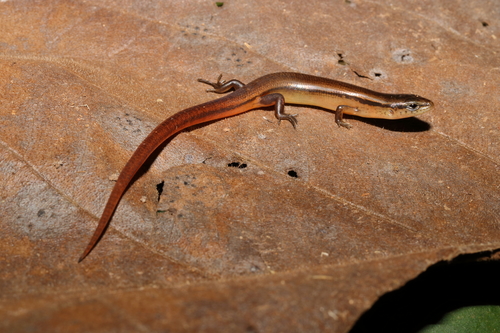
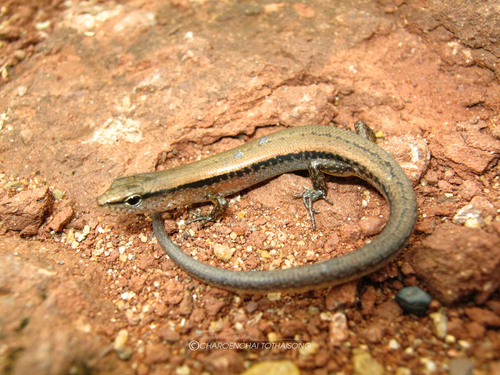
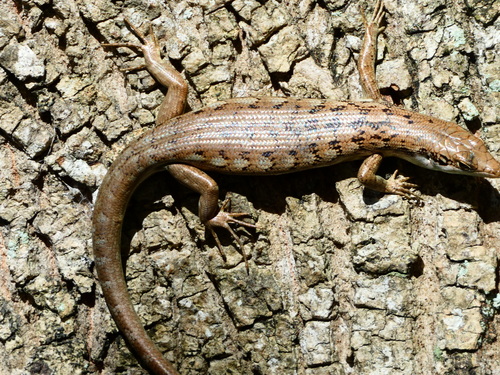
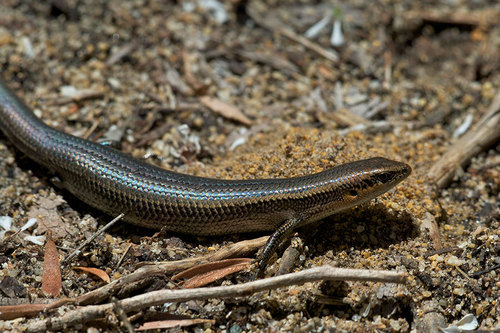
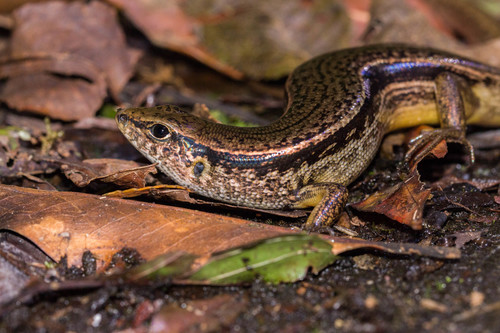
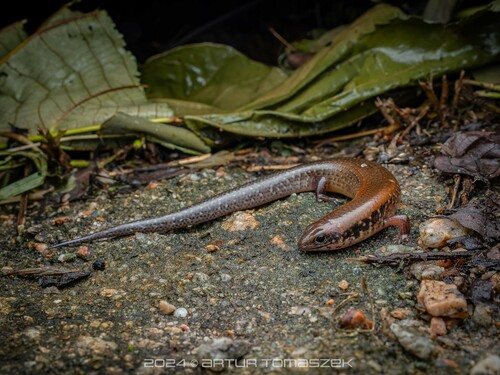
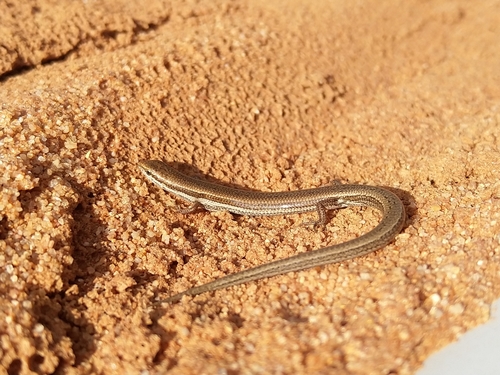
Menetia greyii, commonly called the common dwarf skink, is a very small skink with a maximum snout-to-vent length (SVL) of 38–40 mm (1.5–1.6 in). It has a lightly built, elongated body, smooth scales, and four limbs: the forelimbs have four digits each, while the hindlimbs have five digits each. Its base color ranges from brownish grey to grey. It has dorsal dashes that may form broken lines, along with broad dark upper lateral and white midlateral stripes. Its underbelly is usually white, but breeding males have a distinctive yellow or orange flush on the underbelly and a pink flush on the throat. Some populations show slight color variation adapted to the different environments they inhabit. This species has two supraciliary scales: the first is quite small, and the second contacts the supraocular scale. It has three scales arranged in a line between the eye and the nostril. The common dwarf skink is one of Australia's most widespread and abundant lizards, found across the continent west of the Great Dividing Range. It has not been recorded in north-east Northern Territory, Cape York Peninsula, southern Victoria, or Tasmania, but occurs in all other Australian regions, covering approximately 93% of the continent. A continuous occurrence record map is available online on the Atlas of Living Australia via the reference link. It is widespread across many different habitats, including heaths, deserts, woodlands, grasslands, and frequently urban environments, making it relatively well known. It shelters under logs and rocks, and often moves through ground leaf litter while foraging for its main food source, invertebrates. It can live on a wide variety of soil types. Adult females of this species lay clutches of 1 to 3 eggs. M. greyii is one of the few vertebrate species known to reproduce via parthenogenesis. A 2007 study confirmed that this species can reproduce both by parthenogenesis and by sexual reproduction, with mitochondrial DNA evidence verifying that parthenogenesis occurs in the species. Parthenogenesis is a process where eggs develop into clones of the mother without fertilization; this process can occur in some non-mammal species.