About Memecylon caeruleum Jack
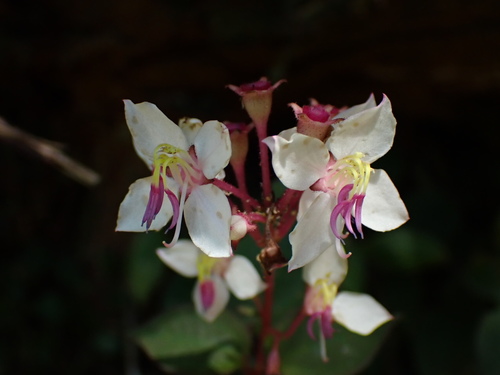
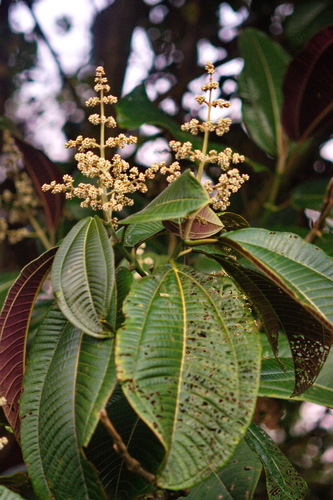
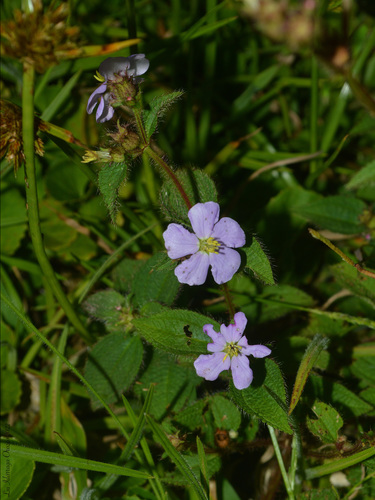
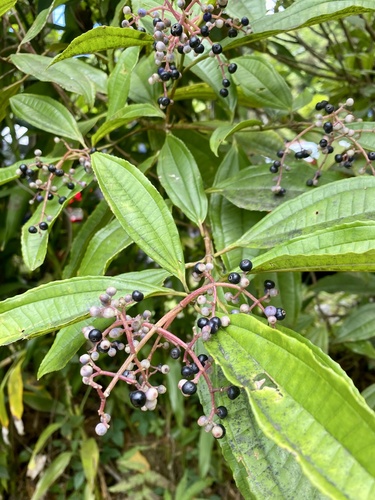
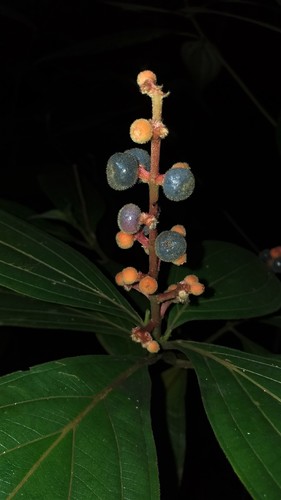
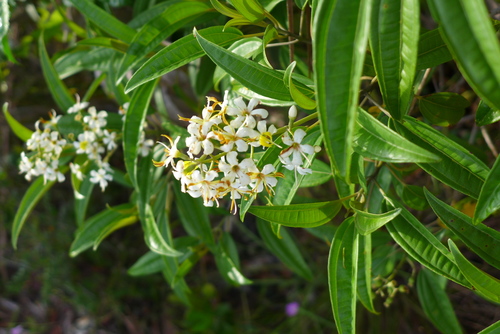
Memecylon caeruleum Jack grows as either a shrub or a tree. It typically reaches heights of 1 to 6 metres, and occasionally grows up to 12 metres tall. It has a circular (terete) trunk with smooth, glabrous bark. Its leathery leaves are oblong to elliptic in shape, measuring 8–11 cm by 3.8–6 cm, rarely up to 16 cm by 7.5 cm. Its flower petals range from white to yellowish green, and it has blue stamens. Its smooth obovoid fruit is pink to dark red when immature, maturing to purple or black. Mature fruits have a diameter of 1 to 1.5 cm and a succulent, juicy outer skin. In its range that includes China, flowering occurs from April to August, with fruits ripening in December and January; fruit colour and size are used as diagnostic characteristics to identify this species in China. In Cambodia, this species flowers in July and bears fruit from October to May. Phylogenetic analysis identifies this species as belonging to a clade with Memecylon cantleyi, which grows in Borneo, Sumatra, Peninsular Malaysia and Thailand. Both of these species are part of a larger Southeast Asian/Malesian clade that also includes Memecylon lilacinum, Memecylon pauciflorum, Memecylon plebujum, and Memecylon scutellatum. This species is native to a range extending from New Guinea, across Malesia, to parts of China. Recorded native regions and countries include: mainland Papua New Guinea; Indonesia (West Papua, Maluku, Sulawesi, Kalimantan, Java, Sumatra); Philippines; Malaysia (Sabah, Sarawak, Peninsular Malaysia); Singapore; Cambodia; Vietnam; Laos; China (Hainan, Yunnan, Tibet); Myanmar; and India (Andaman Islands, Nicobar Islands). It has been introduced to the Seychelles. Across Southeast Asia, the plant grows in secondary vegetation formations. In China, it occurs in open sparse forest through to closed dense forest, at elevations of 900 to 1200 metres. On the slopes of Mount Malindang, a volcano on Mindanao island, Philippines, it grows in secondary forest at around 1650 metres elevation; local assessors note it is rare overall but common in concentrated patches, while assessors from the Philippine National Museum have described it as economically important. On the slopes of Nglanggeran volcano, Gunung Kidul Regency, Indonesia, this shrub dominates forests growing on dry soil, and is commonly associated with Ardisia javanica, Pavetta species, Melastoma malabathricum and Psychotria species. In Kratie and Steung Treng Provinces, Cambodia, this tree or treelet grows along the Mekong river. It occurs in riverine strand, bamboo forest, deciduous forest, and mixed evergreen and deciduous forest communities, growing on sediments derived from metamorphic rock and shale at elevations of 25 to 30 metres. On Mahé island, Seychelles, this non-native plant was first recorded in 1931. It has since expanded to cover a large area and spread to the nearby island of Praslin. It produces dense shade, and the plant community growing alongside it has low diversity. Animal communities living in areas infested by this shrub are mainly made up of cosmopolitan taxa; the most abundant community association is between Technomyrmex albipes ants and Icerya seychellarum scale insects, which are found on the immature fruit. This shrub poses a significant threat to degraded habitats in the Seychelles. In Singapore, two species of leaf-cutting bee, Megachile laticeps and Megachile disjuncta, have been observed collecting pollen from this plant. In Cambodia, the trunks of this shrub are used for firewood. Kuy- and Khmer-speaking people living in villages in Stung Treng and Preah Vihear provinces of north-central Cambodia use the tree as a source of wood. On the Andaman and Nicobar Islands of India, local people eat the leaves or young shoots, and the fruit of this species.