About Membranipora membranacea (Linnaeus, 1767)
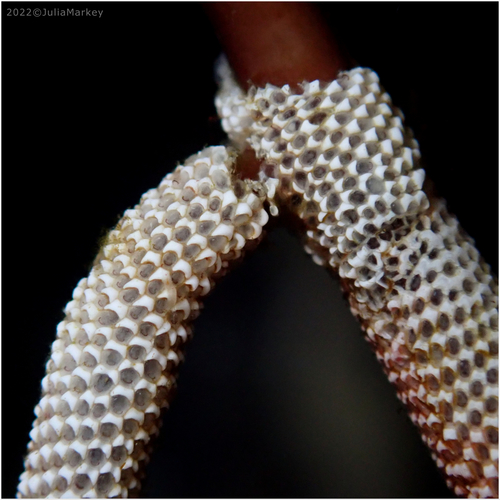
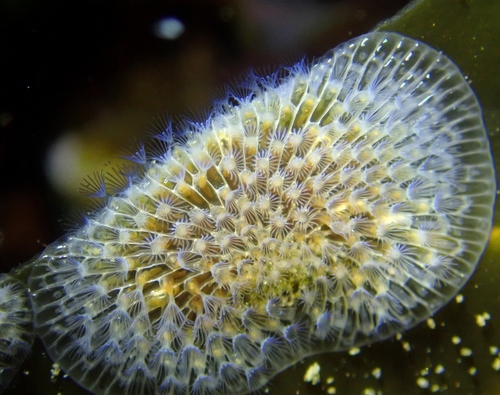
Membranipora membranacea (Linnaeus, 1767) forms colonies made of individual organisms called zooids. Each zooid secretes a chitinous exoskeleton from its epidermis; this exoskeleton, hardened with calcium carbonate, is called the zooecium. The zooecium protects the zooid's internal structures, and permanently anchors the individual to both the substrate and adjacent zooids. Zooids within a colony can communicate through pores in their connecting walls, which allow exchange of coelomic fluid. The living internal portion of a zooid is called the polypide, and its walls are formed by an outer epidermis and an inner peritoneum. A lophophore — a ring of ciliated tentacles — extends from the polypide to feed. When the zooid is not feeding, the lophophore retracts back into the polypide through the tentacular sheath. The lophophore is controlled by the zooid's nervous system, which includes a ganglion located at the base of the lophophore. This ganglion manages motor and sensory impulses traveling to and from the lophophore, as well as the epithelium and digestive tract. The lophophore's movement is controlled by the lophophore retractor muscle. Unlike most other members of its phylum, this species does not have ovicells or avicularia. This species is distributed in the Northeast Atlantic, including the Baltic Sea, English Channel, Mediterranean Sea, and North Sea. It is also native to the North Pacific coastline of North America, ranging from Alaska to California. It was first recorded on the U.S. Atlantic coastline in 1987, in the Gulf of Maine. On Canada's Atlantic coast, it was first observed in Nova Scotia in the early 1990s, and had spread to Newfoundland and Labrador by 2002. It now commonly occurs along the Northwest Atlantic from Long Island Sound to northern Newfoundland, including coastal Quebec, New Brunswick, and Prince Edward Island. M. membranacea favors shallow marine habitats ranging from the mid intertidal to the shallow sublittoral. It can also live in brackish water. Colonies typically attach to seaweed, shells, or artificial substrates. M. membranacea starts its life cycle as a triangular, plankton-feeding larva. After several weeks, the larva attaches to a substrate and undergoes metamorphosis. Larvae usually settle on preferred substrates in May. The colony then goes through growth, stasis and reproduction, shrinkage, and senescence around September, though colonies can persist longer into winter in regions with suitable temperatures. When conspecifics (members of the same species) are present, colonies may stop growing early and enter stasis and reproduction sooner. Predator presence also reduces colony growth. Colonies of M. membranacea are protandrous sequential hermaphrodites: they transition from a male reproductive stage to a female reproductive stage. This allows fertilization to happen either between different colonies or within a single colony. Fertilization occurs in the coelomic fluid of female colonies, and eggs are released through an opening in the lophophore called the coelomophore. Colonies can also grow or reproduce asexually via budding, which occurs in a radial pattern starting from the first established zooid, called the ancestrula.