About Melursus ursinus (Shaw, 1791)
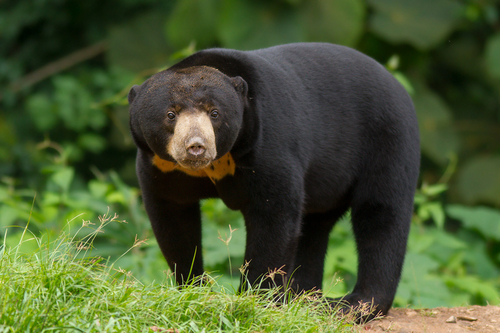
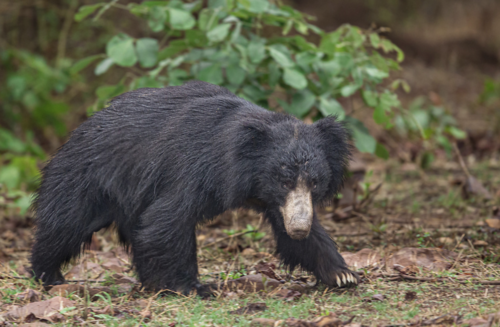
Adult sloth bears (Melursus ursinus) are medium-sized bears with significant variation in weight across subspecies and by sex. Females typically weigh 55 to 105 kg (121 to 231 lb), while males typically weigh 80 to 145 kg (176 to 320 lb). Exceptionally large individuals can reach 124 kg (273 lb) for females and up to 192 kg (423 lb) for males. For the nominate subspecies, the average weight in Nepal was 95 kg (209 lb) for females and 114 kg (251 lb) for males; one study of nominate bears in India found an average weight of 93.2 kg (205 lb) for males and 83.3 kg (184 kg) for females. For the Sri Lankan subspecies M. u. inornatus, the maximum recorded weight is 68.2 kg (150 lb) for females and 104.5 kg (230 lb) for males. However, averages for this subspecies are much lower: six Sri Lankan males averaged only 74.8 kg (165 lb), and four females averaged 57.5 kg (127 lb). This means Sri Lankan sloth bears are around 30% lighter in body mass than the nominate race, and they have more pronounced sexual size dimorphism. Sloth bears stand 60–92 cm (2 ft 0 in – 3 ft 0 in) high at the shoulder, and have a total body length of 1.4–1.9 m (4 ft 7 in – 6 ft 3 in). In addition to being smaller than males, females typically have more fur between their shoulders. Sloth bears have thick, long muzzles, small jaws, bulbous snouts with wide nostrils, and long lower lips that can stretch over the outer edge of their noses. They lack upper incisors, an adaptation that lets them suck up large numbers of insects. Their premolars and molars are smaller than those of other bears, because they do not chew as much vegetation. Adult sloth bears usually have teeth in poor condition, due to the amount of soil they suck up and chew while feeding on insects. The back of their palate is long and broad, which matches the typical form of other ant-eating mammals. Their paws are disproportionately large, with highly developed, sickle-shaped, blunt claws that measure 10 cm (4 in) in length. Their toe pads are connected by a hairless web. They have the longest tail of any bear species, which can grow to 15–18 cm (6–7 in). Their back legs are not very strong, but they are knee-jointed and allow them to assume almost any position. Their ears are very large and floppy; the sloth bear is the only bear species with long hair on its ears. Sloth bear fur is completely black, though some specimens have rusty-colored fur, with the exception of a whitish Y- or V-shaped mark on the chest. This chest mark is sometimes absent, particularly in Sri Lankan specimens. The same marking is also present in Asian black bears and sun bears, and is thought to serve as a threat display, since all three species live in the same range as tigers; tigers usually do not attack an adult bear if the bear is aware of the tiger or facing it. The sloth bear's coat is long, shaggy, and unkempt, despite the relatively warm environment the species lives in. It is particularly thick behind the neck and between the shoulders, forming a mane that can be 30 cm (12 in) long. The belly and underlegs can be almost bare. Sloth bears are usually around the same size as Asian black bears, but are immediately distinct due to their shaggier coat, whitish claws, and typically rangier build. Their head and mouth is highly distinct from that of an Asian black bear, with a longer, narrower skull shape (especially the snout), loose-looking, flappier lips, and a paler muzzle color. Where their ranges overlap, sloth bears are unlikely to be confused with sun bears, as sun bears are considerably smaller, have much shorter fur, wrinkled folded skin (especially around the back), a bolder chest marking, and a drastically different, more compact head structure and overall appearance. The sloth bear's global range includes India, the Terai region of Nepal, temperate climatic zones of Bhutan, and Sri Lanka. It occurs in a wide range of habitats including moist and dry tropical forests, savannahs, scrublands, and grasslands. On the Indian subcontinent, it lives below 1,500 m (4,900 ft), and in Sri Lanka it lives below 300 m (980 ft) in dry forests. It is regionally extinct in Bangladesh. Adult sloth bears may travel in pairs, and males are often observed to be gentle with cubs. They may fight for food. They walk with a slow, shambling motion, placing their feet down in a noisy, flapping movement, but they can gallop faster than a human can run. Although they appear slow and clumsy, both young and adult sloth bears are excellent climbers. They occasionally climb to feed and rest, but not to escape enemies, since they prefer to stand their ground when threatened. As a primary defense against predator attacks, sloth bear mothers carry their cubs up trees instead of sending cubs up to escape on their own. Sloth bear cubs can be threatened by predators such as tigers, leopards, and other bears. Sloth bears are adequate climbers on more accessible trees, but cannot climb as quickly or on as varied a range of surfaces as black bears, due to their more elongated claw structure. Because of their smaller size and still shorter claws, sloth bear cubs probably climb more proficiently than adult sloth bears, just as brown bear cubs can climb well but adult brown bears cannot. Sloth bears are good swimmers, and primarily enter water to play. To mark their territories, sloth bears scrape trees with their forepaws, and rub against trees with their flanks. Sloth bears produce a range of different sounds and vocalizations. Howls, squeals, screams, barks, and trumpet-like calls are made during aggressive encounters, while huffing is used as a warning signal. Chuffing calls are made when the bear is disturbed. Females stay in contact with their cubs with a grunt-whicker, while cubs yelp when they are separated from their mother. The breeding season for sloth bears varies by location. In India, sloth bears mate in April, May, and June, and give birth in December and early January. In Sri Lanka, breeding can occur all year. Female sloth bears (sows) have a gestation period of 210 days, and typically give birth in caves or in shelters under boulders. Litters usually have one or two cubs, and very rarely three. Cubs are born blind, and open their eyes after four weeks. Sloth bear cubs develop quickly compared to most other bear species: they start walking one month after birth, become independent at 24–36 months old, and reach sexual maturity at three years of age. Young cubs ride on their mother's back when she walks, runs, or climbs trees, until they reach one third of the mother's size. Cubs fight to maintain individual riding positions on the mother's back. The interval between litters can last two to three years.