About Melozone crissalis (Vigors, 1839)
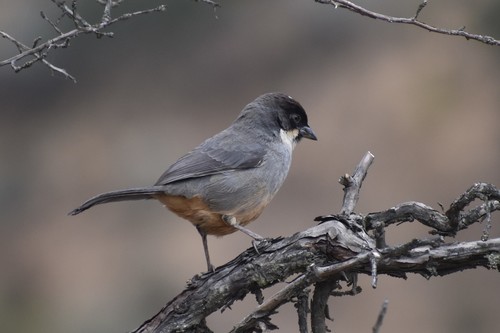
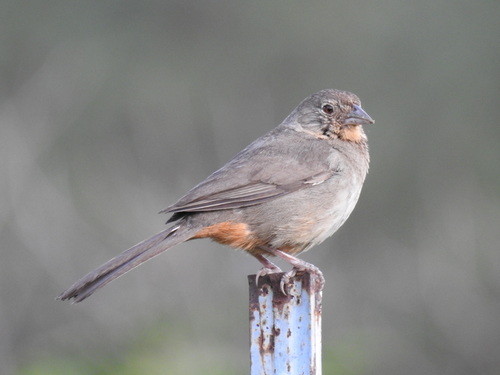
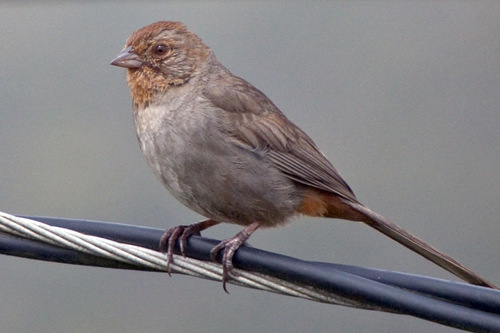
The California towhee (Melozone crissalis) is a species of bird in the family Passerellidae, native to coastal regions of western Oregon and California in the United States, and Baja California and Baja California Sur in Mexico. There has been ongoing debate about the taxonomy of this species. At higher taxonomic levels, some authors place all towhees in the family Fringillidae instead of Passerellidae. Within the genus Melozone, debate has centered on whether California towhee and the closely related canyon towhee (Melozone fuscus) should be classified as separate species or grouped as subspecies of a single species. The two were formerly grouped together under the name brown towhee, but are now recognized as separate species. This separation is supported by their differing feather coloration, the dark central breast spot unique to the canyon towhee, the strong isolation of the two populations from each other, and molecular genetic evidence that currently confirms they are separate species. In contrast, there is little genetic distinction between the northern and Baja Californian populations of M. crissalis. Currently, scientists identify Abert's towhee as the closest relative of the California towhee, based on similar DNA and physical patterns. The natural breeding habitat of the California towhee includes brush, chaparral, open woodlands, and areas along streams adjacent to desert slopes in California, and it also occurs throughout Baja California. Its range extends along the North Pacific coastline from southern Oregon, USA, south to Baja California, Mexico. This is a non-migratory species, and individuals only change their home ranges when seeking a mate. It has also adapted widely to live in human-created parks and gardens, and is common in rural and less densely populated suburban areas. The California towhee is classified as Least Concern, with no imminent major threats to its overall population. According to the National Audubon Society, the three most significant threats to the species are fire weather, spring heat waves, and urbanization. Wildfire threatens California towhees because they typically hide in shrubbery, and birds in dense forested areas during wildfires may be killed. However, the species' reproductive patterns allow general populations to remain largely unaffected after wildfire. Spring heat waves increase local temperatures, reduce water and other resource supplies, and disrupt food chains, which impacts the California towhee but does not reduce the overall population enough to change its conservation status. While urbanization is a major threat for many species, the California towhee has adapted well to living near and alongside humans. Currently, the species' total range is not projected to change in size, but continued or accelerated global warming could greatly reduce its overall range and population. If summer temperatures within the species' current range increase by 1.5 to 3 °C (34.7 to 37.4 °F), available habitat could increase by at least 2%, though this would require the species to shift its range uphill. In contrast, the same 1.5 to 3 °C winter temperature increase would reduce the species' range by a minimum of 20% and a maximum of 77%. This demonstrates the fragility of the ecosystems the California towhee depends on, particularly since the species does not migrate. In terms of behavior and ecology, the California towhee forages for food on the ground or in low scrub. Its diet is primarily made up of a variety of seeds, grasses, and herbs; when feeding on grass seeds, it can strip all seeds from a stalk at once using its beak. During the breeding season, it adds insects such as grasshoppers and beetles to its diet, and may also eat snails, millipedes, and spiders. It is most often seen traveling or feeding alone or in pairs, and is very active while on the ground. When foraging, it uses a characteristic "double-scratch" maneuver: it lunges forward then hops backwards to scratch the ground with its feet, uncovering food hidden under leaf litter. It will also visit bird feeders, and often eats millet that other bird species reject. It can run quickly over short distances, and pairs stay in constant contact; California towhees may form lifelong pair bonds. Though California towhees drink freely when water is available, both in the wild and in captivity, individuals in drier habitats can meet most of their water needs from the insects and succulent plant materials they eat. The California towhee's call is a single note that has been described by listeners as seet, tseek, tsip, cheet, cheenk or peenk, and its song is a long, repeated series of notes that ends with a trill.