About Meloe americanus Leach, 1815
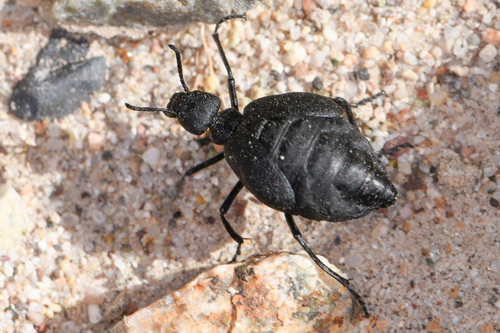
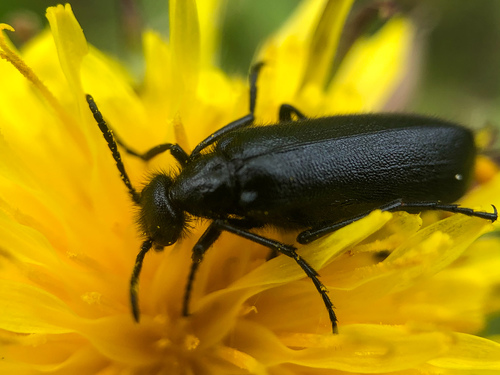
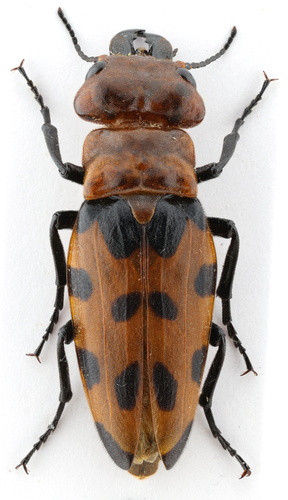
Meloe americanus, commonly known as the American oil beetle, is a species of blister beetle. It belongs to the genus Meloe, one of the larger genera in the Meloidae family, which has 146 known species. The group is called "oil beetles" because members release a fluid from their joints when threatened. Adult body length of Meloe americanus ranges from 7 mm to 17 mm. Members of this species are entirely black, and sometimes display a blue metallic hue. They are soft-bodied with long legs, and their neck region is narrower than their head and abdomen. Their elytra are short and abbreviated, and they do not have hind wings, so adult Meloe americanus cannot fly. Females and males have similar overall appearances, with females generally larger than males. There is sexual dimorphism in antennal structure: females have straight, linear antennae, while males have a bend around the middle of their antennae. Meloe americanus is native to the northeastern United States, and can also be found in the central and southern United States. Out of all species in the Meloe genus, M. americanus is one of two that can be found in Mississippi, Louisiana, and Alabama. The presence of M. americanus in the southern United States can be explained by mild winters and the seasonal flowering activity of forbs that attract Apoidea. Most Meloe species show a correlation between their geographic distribution pattern and their adult seasonal activity. M. americanus adults become active during late autumn to early winter, which explains why they can be found in areas with milder climates. M. americanus prefers mesic habitats and temperate climates. These beetles can be found in lowland terrains, including farms, woodlands, and open grassy areas. Their habitat is influenced by their food preferences, so they are found in areas where certain plants and insects are prevalent. Many of their favorite plants to feed on grow abundantly at the bottom of wooded ravines, so they are often encountered there. When they are not mating or foraging, they can be found hiding under objects like leaves, logs, and rocks. Beetles generally have four life stages: egg, larva, pupa, and adult. Meloe eggs range in color from yellow to deep orange, are cylindrical, and about 0.5 to 2 mm long. Eggs can hatch within 30 days, but sometimes it can take up to 130 days or more for larvae to emerge after eggs are laid. For M. americanus, the remaining larval, pupal, and adult stages are divided into nine instars. Larvae are less than 1.6 mm in length, and light to dark brown in color. The larval stage is split into four stages spanning seven instars. The first instar is called the triungulin phase, when triungulin larvae emerge. Triungulin larvae are the most active of all larval stages. They climb foliage and wait for potential hosts to attach to, so they can be transported to a host's nest where further development occurs. The second through fifth instars make up the first grub phase. In this phase, larvae are still active, feeding and maturing inside bee cells. The next stage is the coarctate phase, or the sixth instar. Larvae in this phase become increasingly inactive and sedentary. The seventh instar is the second grub phase, and these larvae are completely inactive. The pupal stage is the eighth instar, and the adult stage is the ninth and final instar. Temporal patterns of development depend on temperature. Adult M. americanus emerge from the soil between winter and spring, with peak emergence in December and April. During this time, they forage, mate, and oviposit. Triungulin larvae initially appear in the fall, are not seen during winter, and then reemerge in the spring, with peak activity in October and April. The coarctate phase is entered in spring and early summer, and completed from summer through early fall. Development inside bee larval cells takes 60 to 90 days. Adults and larvae of M. americanus have distinct diets. Adults are phytophagous, meaning they only eat plants. They feed on the flowers, stems, and leaves of herbaceous plants. The most common plant families that M. americanus feeds on are Ranunculaceae and Compositae. Most of the plants adult beetles eat are relatively small, so they feed at or near ground level, which makes them vulnerable to predators. For this reason, they do not spend as much time resting on their food plants as other blister beetles do. M. americanus larvae are entomophagous, meaning they eat other insects. Their food sources include grasshopper eggs, bee eggs and larvae, and any provisions found in bee nests. Bee larval cells are provisioned with a viscous mixture of nectar and pollen, with bee eggs placed on top of the provisions. Larvae reach these cells via phoresy, the act of latching onto another insect for dispersal.