About Melo amphora (Lightfoot, 1786)
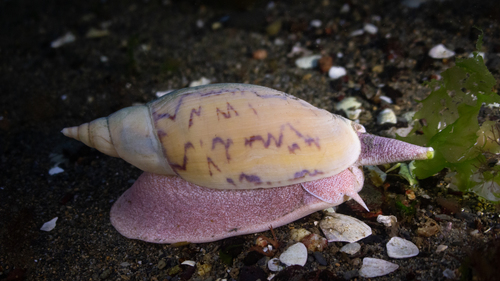
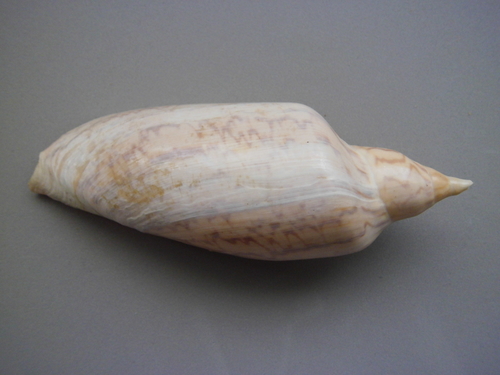
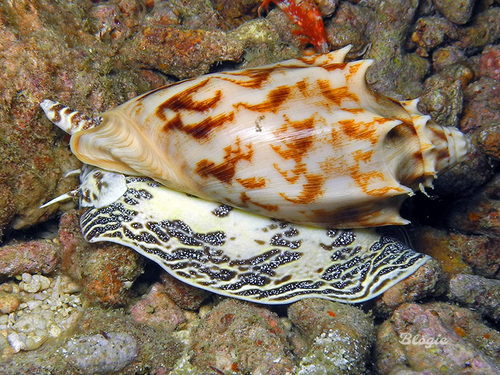
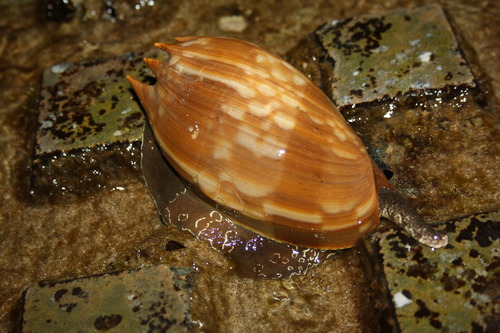
Shell description: The maximum shell length of Melo amphora reaches up to 500 mm, and most individuals grow to around 300 mm. This large shell has a bulbous or nearly oval shape. Its columella features three clearly distinguishable oblique folds. The aperture is wide, almost as long as the entire shell, and there is no operculum. The species has a very large, inflated body whorl that is expanded toward the posterior end. One of its most noticeable characteristics is a shoulder marked by prominent, curved hollow spines. These spines typically become less distinct as the snail continues to grow. The spire is usually very short. Shell color of Melo amphora is highly variable. Most shells are primarily brown, white, or pale orange, and commonly have darker brown spiral banding. The interior of the shell is glazed, and is usually cream or pinky orange in color.
Distribution: This species is found only in the tropical southwest Pacific, ranging from southern Indonesia and New Guinea to the northern half of Australia.
Habitat: This large sea snail lives in littoral and shallow sublittoral zones. It most often lives on muddy bottoms, at a maximum depth of close to 10 m.
Human use: The flesh of Melo amphora is edible, and it is commonly eaten by native fishermen. Due to its large size and distinct shell ornamentation, the shell of Melo amphora is highly valued as a decorative object. Like other species in the Melo genus, it is also used as a water carrier and a bailer for fishing boats.