About Mellita quinquiesperforata (Leske, 1778)
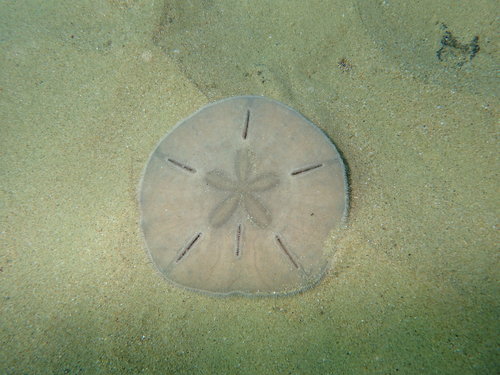
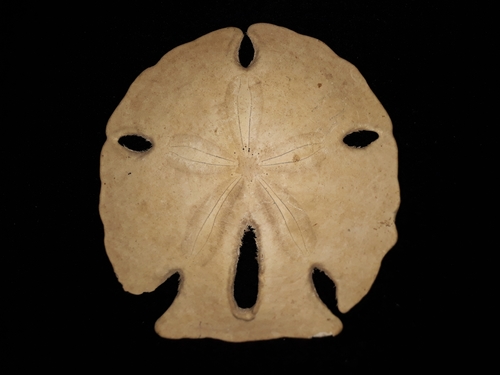
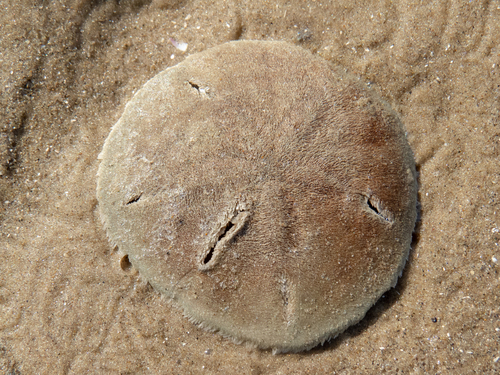
Mellita quinquiesperforata (Leske, 1778) is a tropical species of sand dollar, a flat, round marine animal belonging to the echinoderm group, related to sea urchins and starfish. Individuals of this species have significantly more food in their guts at night than during the day. Inverted individuals of this species can recognize flow direction, and modify their orientation to maximize lift and drag to right their position. This species is also commonly called the five-holed keyhole urchin. It is distributed across the Atlantic Ocean, off the eastern coasts of North, Central, and South America; specifically, it can be found along the eastern coast of the United States, the entire coast of Brazil, and all areas near the coast of South Carolina from Hilton Head to Myrtle Beach. Dried exoskeletons of Mellita quinquiesperforata are commonly found on sandy beaches, often in the high tide zone. This five-holed keyhole urchin prefers habitats with fine-grained sand in the infralittoral zone, a shallow marine region dominated by marine algae. To avoid being tossed around by currents, they form large extensive beds that run parallel to the shoreline, just beyond the breaker zone. Research has found that bed structure and density of this species are linked to the dynamic conditions of tidal zones, and can vary between different beaches. Spatial dispersion of individuals within a bed, as well as individual growth rate, is also correlated with water depth. Five-holed keyhole urchins are dioecious, and reproduce sexually via external fertilization. Their breeding season usually runs from spring to summer, and produces millions of free-swimming offspring. After the larval stage, young urchins eat and store sand to add weight to their bodies. While Mellita quinquiesperforata larvae have bilateral symmetry, adult individuals have radial symmetry.