About Mellisuga minima (Linnaeus, 1758)
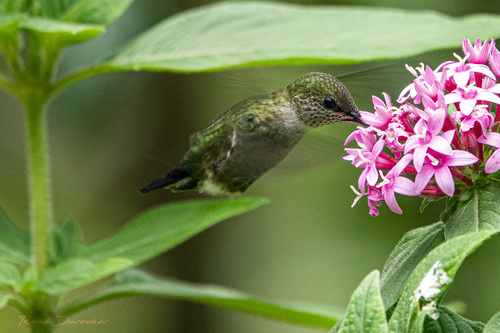
The vervain hummingbird (Mellisuga minima) is widely considered the world's second-smallest bird species, smaller than only the bee hummingbird, though several other tiny bird species are very close to it in size. This species reaches about 6 cm (2.4 in) in total length, including a 1 cm (0.39 in) bill, and weighs between 2 and 2.4 g (0.071 to 0.085 oz). Male and female vervain hummingbirds are nearly identical in appearance apart from their tail shape; subspecies of this species only show very subtle differences in plumage. All individuals of this species have a short, straight, dull black bill. Unlike most other hummingbirds, male vervain hummingbirds have no iridescent feathers. Males have dull metallic green coloring on their upper body, with almost black coloring on the rump and uppertail coverts. Their chin, throat, and chest are pale gray with light dark gray spotting, while their belly and undertail coverts are dark metallic green. The male's tail is entirely black and slightly forked. Females have dark metallic green to bluish green coloring on their upper body and flanks. Their throat is pale gray, and this coloring darkens along the underparts toward the vent area. The female's tail is rounded, rather than forked like the male's. The central tail feathers of females are dark green at the base and black for the rest of their length; the other tail feathers are black with variable amounts of white at their tips. Two subspecies of vervain hummingbird are recognized. The nominate subspecies is native to Jamaica. The subspecies M. m. vielloti occurs on Hispaniola, which includes both the Dominican Republic and Haiti, as well as smaller islands located near Hispaniola. There is a single recorded sighting of this species from Puerto Rico. Across its range, the vervain hummingbird lives in nearly every type of available landscape, with the only exception being the interior of dense montane forest. It can be found in gallery forest, dry forest, desert scrub-shrub, gardens, and even urban areas. Its elevational range extends from sea level up to at least 1,600 m (5,200 ft).