About Mellisuga helenae (Lembeye, 1850)
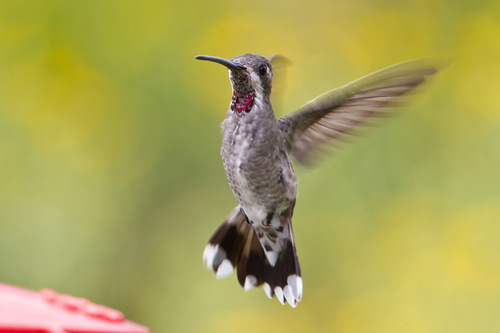
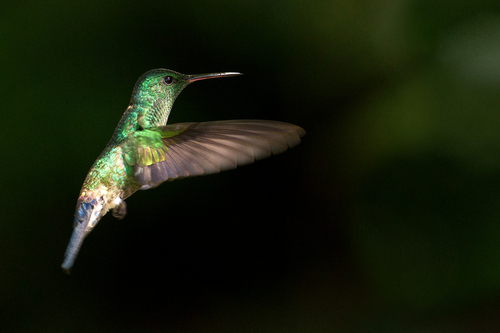
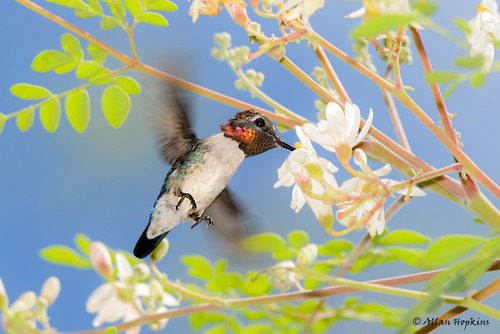
Mellisuga helenae, commonly known as the bee hummingbird, is the smallest living bird. Females are slightly larger than males: females weigh 2.6 g (0.092 oz) and measure 6.1 cm (2+3⁄8 in) long, while males have an average weight of 1.95 g (0.069 oz) and an average length of 5.5 cm (2+1⁄8 in). Like all hummingbirds, it is a swift, strong flier. Compared to other small hummingbirds that often have a slender build, the bee hummingbird has a rounded, plump appearance. The male has a green crown (pileum), a bright red iridescent gorget with elongated lateral plumes, bluish upperparts, and mostly greyish white underparts. During mating season, males develop a reddish to pink coloration on their head, chin, and throat. Females are bluish green with a pale gray underside, and their tail feathers have white spots at the tips. The bee hummingbird’s feathers are iridescent, a trait that is not always visible and changes depending on the viewing angle. It has a slender, pointed bill adapted for probing deep into flowers. The female lays only two eggs at a time, and each egg is about the size of a coffee bean. The bee hummingbird feeds mainly on nectar, moving its tongue rapidly in and out of its mouth to feed. While feeding, pollen collects on its bill and head, and it transfers this pollen as it flies between flowers, playing an important role in plant reproduction. In a single day, a bee hummingbird may visit as many as 1,500 flowers. It is a diurnal bird, capable of flying at speeds of 40–48 km/h (22–26 kn; 11–13 m/s), and beats its wings 80–200 times per second. This wingbeat allows it to remain stationary in the air while feeding from flowers. In the wild, the bee hummingbird can live up to seven years, and it can live up to 10 years in captivity. Because birds are recognized as a living group of theropod dinosaurs, specifically avian dinosaurs, the bee hummingbird has also been described as the smallest dinosaur, as no smaller bird or non-avian dinosaur has been found in the fossil record. Its call is described as a "high pitched, jumbled twitter". Males will often sing from the top of the highest tree within their territory. The bee hummingbird is endemic to the entire Cuban archipelago in the West Indies, including the main island of Cuba and Isla de la Juventud. In this range, it generally inhabits areas of thick growth that contain lianas and epiphytes. Its population is fragmented across Cuba: it occurs in the country’s mogote areas of Pinar del Río Province, is more common in Zapata Swamp (Matanzas Province) and eastern Cuba, and has documented reference localities in Alexander Humboldt National Park and Baitiquirí Ecological Reserve (Guantánamo Province), as well as Gibara and Sierra Cristal (Holguín Province).