About Melithreptus gularis (Gould, 1837)
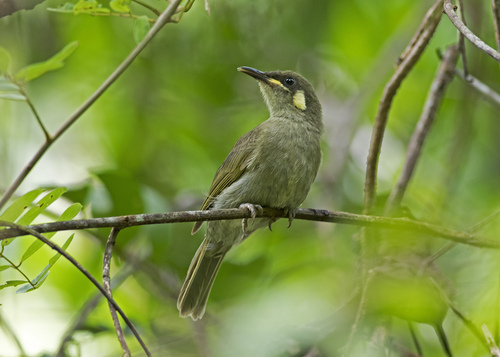
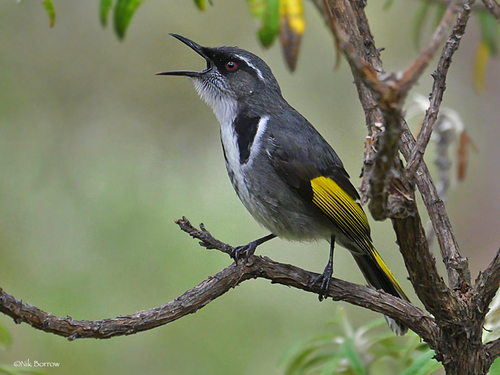
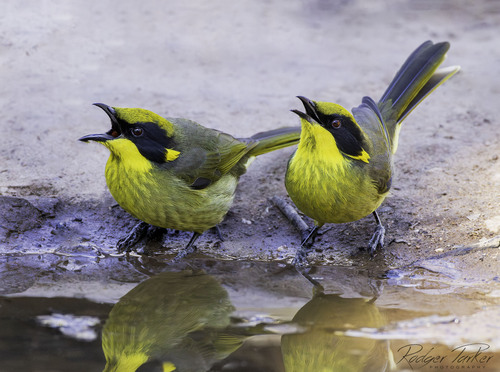
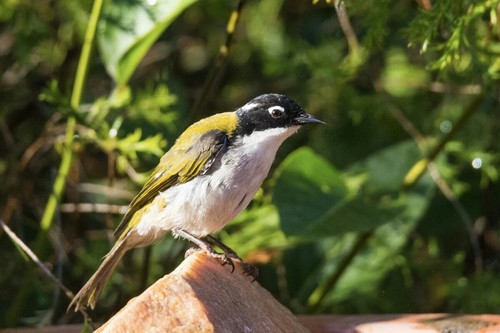
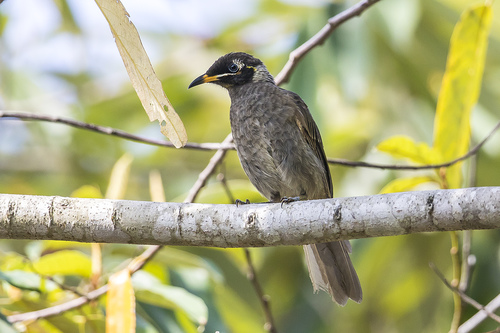
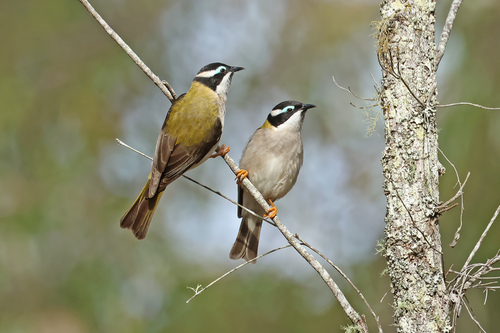
This species, the black-chinned honeyeater, is a mid-sized honeyeater that measures 14 to 16 cm (5.6–6.4 in) in length. Adult birds have olive-brown upperparts and buff underparts, with black coloring on the head, nape, and throat. They have a bluish patch of bare skin above the eye and a white crescent-shaped patch on the nape, and their legs and feet are orange. Juveniles have uniformly browner plumage. The species produces two distinct calls: a scratchy creep-creep-creep call, and a more musical call. According to researcher Ford, individuals found from southeastern Queensland northward have more yellow-tinged upperparts and paler underparts, and those in northeastern Queensland more closely resemble the golden-backed subspecies, while still retaining aqua-blue bare skin around the eyes. The golden-backed subspecies differs from the nominate form in multiple traits: it has a yellow nape and rump, a green-yellow back, less black coverage on the chin, a grey-white breast rather than buff, white flanks and abdomen, lighter brown wings, green-edged rectrices, and yellow-green bare skin around the eyes. The black-chinned honeyeater ranges across northern Australia: its distribution extends from northwest Western Australia, including the Kimberley, Pilbara, Great Sandy Desert, and northern Gibson Desert, through the Top End and Gulf Country to Cape York in Queensland, then through central and eastern Queensland into central New South Wales. It occurs east of the Great Divide in the Northern Rivers region of New South Wales, but is rare further south and has experienced population decline in the Sydney region. It is also found across central and northern Victoria and into eastern South Australia. It is classified as vulnerable in New South Wales and South Australia, but the species as a whole is considered secure globally. It inhabits open woodland and dry sclerophyll forest, and is often found near watercourses. The species is not present in savanna on the western edge of the Einasleigh Uplands, particularly around the Newcastle and Gregory Ranges.