About Melithreptus chloropsis Gould, 1848
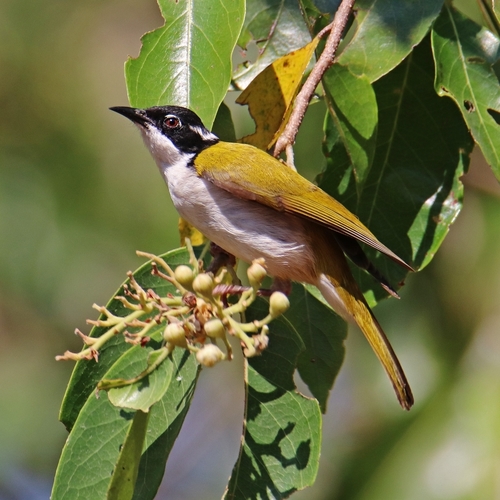
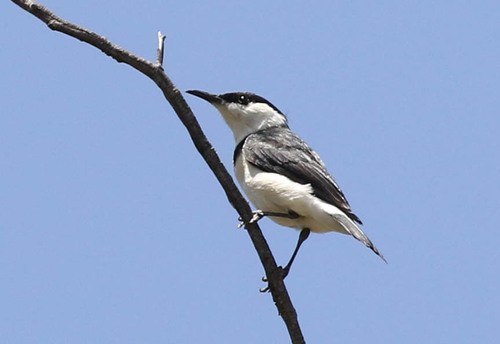
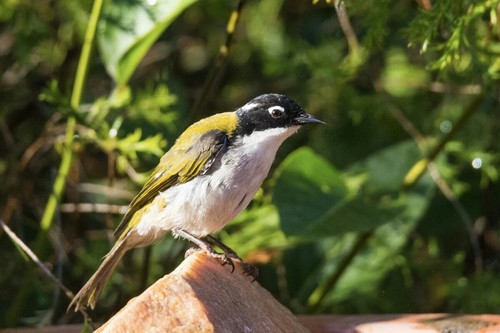
Gilbert's honeyeater, scientifically named Melithreptus chloropsis Gould, 1848, is a mid-sized honeyeater. It has olive-green upperparts and white underparts extending to the undertail. Both the olive and white feathers have grey bases, which become visible when the plumage is ruffled. The white feathers on its flanks have dusky tips. It has a black head, nape and throat, a white patch above the eye, and a white crescent-shaped patch on the nape that is thinner than the equivalent patch found on other related species. Its bill is brownish-black, and its eyes are a dull red. Within its geographic range, its plumage is distinctive enough that it is rarely confused with other species. The only exceptions are the related white-throated honeyeater, which occurs much further north, and the brown-headed honeyeater. Gilbert's honeyeater is extremely similar in appearance to the white-naped honeyeater; the plumage of the two species is identical, except for the color of the bare skin around the eye: this area is pale-green to off-white in Gilbert's honeyeater, and red in the white-naped honeyeater. Gilbert's honeyeater also has a longer bill and tarsus, and is slightly larger overall than the white-naped honeyeater. This species is found in the southwest corner of Western Australia, where its range extends from Moora in the north, through the jarrah forest belt to Broomehill, the Stirling Range, and along the coast to Stokes Inlet. It inhabits several different vegetation types: inland, it lives in dry sclerophyll forests dominated by jarrah (Eucalyptus marginata), karri (E. diversicolor) or marri (Corymbia calophylla); on the coastal plain it inhabits areas of tuart (E. gomphocephala), flooded gum (E. rudis) or narrow-leaved paperbark (Melaleuca laxiflora); it also occurs in wandoo (E. wandoo) woodland. Gilbert's honeyeater is generally sedentary or locally nomadic; populations on the Swan Coastal Plain typically move very little. The species has become less common across the Swan Coastal Plain, and it has completely disappeared from the area of Kellerberrin.