About Melithaea ochracea (Linnaeus, 1758)
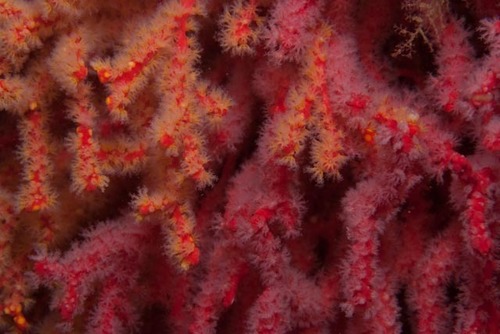
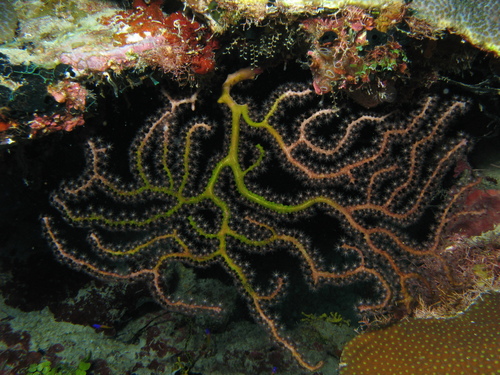
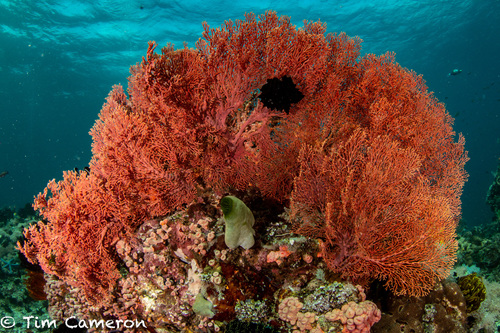
Colonies of Melithaea ochracea are arborescent and usually reach about 20 cm (8 in) in length, though much larger specimens exist. They grow in a single plane, forming a branching, fan-shaped structure. The main skeletal stalk and branches are jointed, with swellings at the larger joints. Internodes are made of hard, calcareous material, while the flexible joints are composed of horny material. The skeleton is covered by a flexible membrane called the mesoglea, which contains tiny calcareous spicules, also called sclerites. The form of these sclerites is important for distinguishing between closely related species. In Melithaea ochracea, sclerites include capstans, double discs, disc-spindles, unilaterally spinose spindles, plain spindles, clubs, and anthocodial sclerites. Three sides of the branches are densely covered in calyces, dome-shaped perforated structures from which polyps protrude. Colony colour varies, but most often falls into shades of yellow, orange, red, and white; sometimes calyces and polyps have contrasting colours. This is an azooxanthellate coral, meaning it does not host symbiotic unicellular algae in its tissues. In Singapore, it sometimes grows near the low tide mark at depths less than 3 metres (9.8 ft); colonies in this shallow zone grow larger than deeper water specimens, and most have yellow branches with red calyces. At greater depths, down to 15 metres (49 ft), colonies are smaller and display different colour combinations. Melithaea ochracea grows on shallow reefs in the South China Sea, between Taiwan and Indonesia. Its distribution also includes Singapore and Malaysia. In Taiwan, it is the most widespread gorgonian coral, found on the higher parts of reef fronts. Its numerous small polyps can feed at water flow rates ranging from 4 to 40 centimetres (1.6 to 15.7 in) per second. Melithaea ochracea can be used in reef aquaria to add visual interest to fish tanks. It requires a moderate water flow to allow its polyps to feed on non-evasive zooplankton, and likely also phytoplankton. In the jewellery industry, Melithaea ochracea is known as sponge coral due to the porous nature of its structure. Bright orange-red specimens are considered the most desirable, but variegated specimens with yellow or orange streaks are also sought after. Most sponge coral sold on the market has been stabilised by being filled with resin or polymer and polished. It is also sometimes dyed, or crushed and mixed with epoxy resin to be formed into a desired shape. It can be carved, and is popular because it is relatively inexpensive. Natural, unenhanced coral is more expensive than treated material, but it is difficult to find enough attractive rough natural material on the market. This coral has a Mohs hardness of 3.5, meaning it is easy to work with but also easy to damage. It should not be worn directly against the skin, as it may become stained. It is harvested in the South China Sea between Taiwan and Indonesia, and is sometimes farmed. It grows much more quickly than the traditional hard corals (Corallium spp.) used in jewellery, and its harvesting is considered sustainable.