About Melitaea didyma Esper, 1780
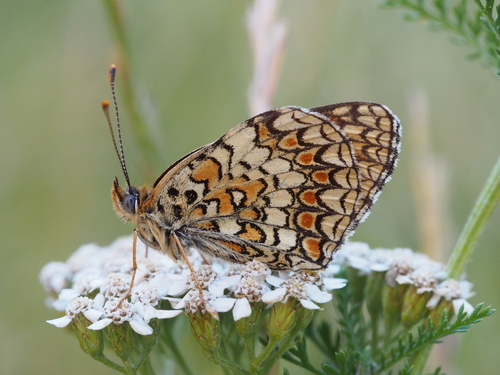
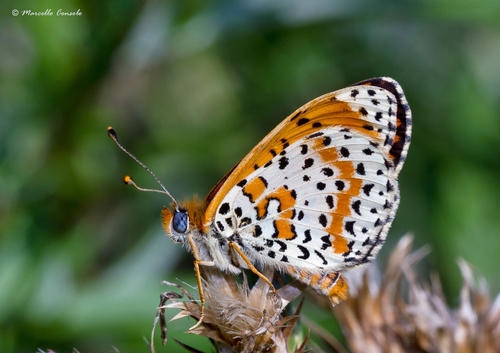
Melitaea didyma (Esper, 1780) is a medium-sized butterfly with a wingspan of 35–50 millimetres (1.4–2.0 in). The upperside of its wings is bright orange-brown, marked with rows of dark brown markings that vary quite a lot in quantity and size. Females sometimes have duller orange wing colour shaded with grey-green. The underside of the wings is chequered pale yellow and pale orange. This species displays seasonal forms and sexual dimorphism.
Males have fiery red upperside wings, with a narrow toothed black distal border and a moderate number of small black dots and spots. These spots are scattered across the basal half of the wing, and end in a short band that extends beyond the cell from the costa into the disc. The underside of male wings has a delicate greenish or yellowish white base, and is heavily marked with small black dots and hook-shaped markings, plus a wavy subbasal band and a curved submarginal band.
In females, the forewing and the anal area of the hindwing are much paler, and are additionally dusted with blackish scales, while the costal half of the hindwing retains the red tint. The entire wings of females have more black markings overall, but these markings are less prominent. Rarely, some specimens have a blue gloss on the wing upperside.
This species is distributed across southern and central Europe, North Africa, the Middle East, central Asia and Siberia. It is not present in northern Europe, including England, Ireland, northern France, Germany, Poland and Scandinavia. It prefers to live in flowery grassy areas, meadows and roadsides.