About Melitaea diamina (Lang, 1789)
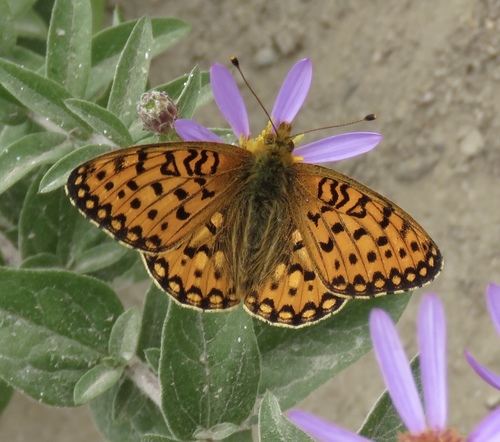
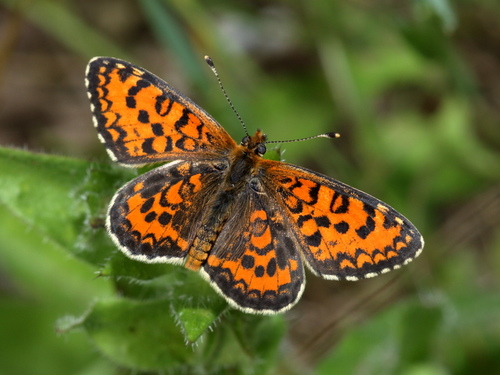
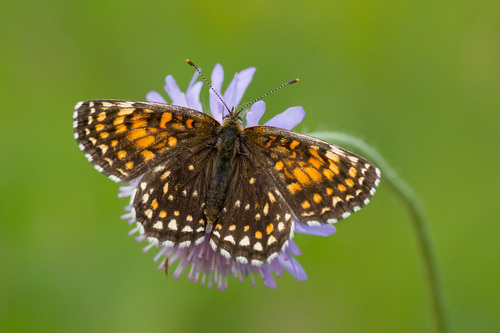
Melitaea diamina, first described by Lang in 1789, has a wingspan of 36–42 mm, with females larger than males. This medium-sized species displays high variation in the size of black markings and the range of ground color on the upper wing surface. The upper side of the wings is typically black brown, with a yellowish-orange ground color and a white chequered fringe. The upper side of the hindwings features very heavy dark markings, and the upperside may sometimes be uniformly dark brown. The underside of the hindwings has a submarginal row of white half-moon shapes and several bands of creamy-white and orange checkered patterns. In Seitz's description, this species, referred to as M. dictynna Esp. (= corythalia Hhn.), is much darker on the upperside than earlier related species, with heavy black markings. In males, only small rounded spots on the forewing and a submarginal row of dots on the hindwing are reddish yellow. In females, the outer half of the upperside is variegated with ivory yellow and ochreous spots, and both sexes have white fringes. The underside markings resemble those of M. athalia, but the bands on the hindwing are more chestnut in color. It is found across Europe except for the extreme north, extreme south, and Great Britain, and also ranges across North and Central Asia eastward to the Pacific coasts. It is abundant almost everywhere in the western part of its range, and rarer in the eastern and northern parts. Unusually light and dark specimens are not rare; according to Spuler, these are named ab. corythalia and ab. navarina respectively. The subspecies form erycina Stgr. (originally credited to Staudinger, now recognized as erycina Lederer, subspecies qv.) from Amurland and the Altai is almost identical to European specimens on the upperside, but has slightly paler spots. It is more variegated on the underside, with the brown submarginal band paler below the costa but not interrupted, and specimens from northern Amurland are slightly smaller. This subspecies is not common anywhere, per Graeser. The subspecies erycinides Stgr., now subspecies qv., is a large race from Central Asia and certain sites farther east. Males have dark-spotted uppersides, while females have whitish yellow-spotted uppersides. The submarginal band on the underside is much darker brown than in European specimens, and the margin of the forewing underside is broadly shaded with dark brown. The larva of what was then called dictynna is dark grey with yellow spines, and the body bears bluish dots, with two such dots on the head. Black longitudinal stripes run along the back. Larvae develop from autumn until May, feeding on Plantago, Veronica, Valeriana, and other genera. The pupa is silvery grey or yellowish grey, dotted with black, and has rows of small russet-yellow warts on the dorsal side of the abdomen. Adult butterflies are active from June until August, and inhabit swampy meadows, especially areas near water-ditches and wooded meadows. They are slow fliers, reportedly the slowest among all Melitaea species. In the high Alps, they occupy the same localities as many Erebia species, and fly alongside them, occurring up to 10,000 feet. This species is widespread in central and southern Europe, ranging from northern Spain, southern and eastern France, and Italy eastward into southern Scandinavia and Bulgaria. It is also found in southern Siberia, north-eastern China, southern Ussuri, Korea and Japan. These butterflies inhabit damp flowery meadows, woodland margins, and woodland rides, ranging from low elevations up to alpine levels at 2200 m.