About Melitaea athalia Wachtelweizen-Scheckenfalter
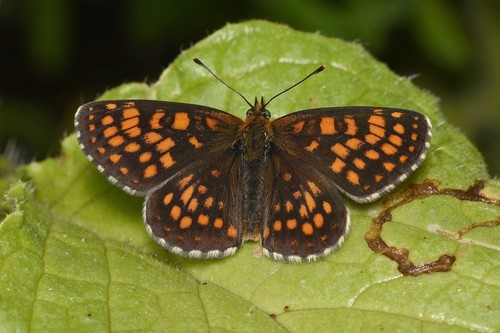
Heath fritillary (Melitaea athalia) has a wingspan of 39–47 mm. The upperside of its wings is predominantly dark brown and orange brown, with orange-brown spots outlined by dark brown along and across the wing veins. The wings have a white fringe, through which dark brown markings extend. The upperside of the body matches the dark brown wing color, and the base of both wings is also dark brown. The underside of the wings features bands of red and off-white; each wing vein is dark brown, and all color sections are outlined with dark brown. The pattern of white spots at the base of the hindwing, which is visible when the butterfly is at rest, is a key diagnostic feature for identification. This species' wing pattern is very similar to that of Melitaea cinxia, but the dark brown bands on the underside of the wings are more distinct in heath fritillary than in M. cinxia. The heath fritillary's range spans the entire Palaearctic region, from western Europe to Japan. In Europe, it is not found in Iceland, Ireland, Scotland, Wales, southern Portugal, southern Spain, the Mediterranean islands, and southern Greece. In the United Kingdom, it is restricted to specific locations: grasslands (abandoned hay meadows) in Cornwall and Devon, heathland on Exmoor, and acid-soil coppiced woodland in Kent and Essex. Populations in Essex are the result of reintroduction projects, and additional reintroductions are currently ongoing in other parts of the UK. In the late 1990s, the species was estimated to occupy just 0.2% of the area within the 10-km grid squares covering its entire UK range. Its altitudinal range extends from sea level up to 2600 m. Within Europe, the heath fritillary lives in a wide variety of grassy, flowery habitats, which may be dry or damp, upland or lowland, and can be with or without shrubs or trees; these habitats include woodland clearings and heathland. More specifically in England, the species occupies three distinct habitat types: unimproved grassland with abundant short (5–15 cm) or sparse swards of ribwort plantain or germander speedwell (or both) growing on stony soils, which sometimes takes the form of abandoned hay meadows; sheltered heathland with common cow-wheat scattered among bilberry-dominated vegetation, located in valleys with mineral soils; and coppiced woodland (especially clearings within it) with common cow-wheat growing on acid soils. In France, the species is also found on unimproved hay meadows and pastures.