About Melissa officinalis L.
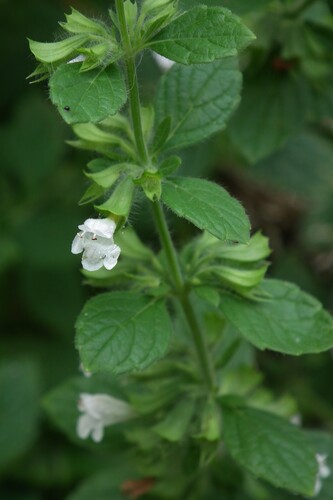
Melissa officinalis L., commonly known as lemon balm, is a perennial herbaceous plant belonging to the mint family, Lamiaceae. It grows bushy and upright, reaching a maximum height of 100 centimetres (39 in). Its heart-shaped leaves measure 2–8 cm (3⁄4–3+1⁄4 in) long, with a rough, veined surface. Leaves are soft, hairy, and have scalloped edges, and give off a mild lemon scent. Small white or pale pink flowers bloom during summer. Individual lemon balm plants can live for ten years; when grown as a crop, plants are replaced after five years to let the ground rejuvenate. Lemon balm is native to south-central Europe, the Mediterranean Basin, Central Asia and Iran, but is now naturalized in the Americas and other regions around the world. It grows easily from seed, and prefers rich, moist soil. For germination, lemon balm seeds require light and a minimum temperature of 20 °C (68 °F). The plant grows in clumps, and spreads both by seed and vegetatively, with new plants growing from fragments of parent plants. In mild temperate zones, the plant's stems die back at the start of winter, and regrow in spring. Lemon balm grows very vigorously. As of 1992, Hungary, Egypt, and Italy are the major producing countries of lemon balm. In the northern hemisphere, leaves are harvested by hand in June and August, on dry days, to prevent the harvested crop from turning black when damp. Cultivars of M. officinalis include M. officinalis 'Citronella', M. officinalis 'Lemonella', M. officinalis 'Quedlinburger', M. officinalis 'Lime', M. officinalis 'Mandarina', M. officinalis 'Variegata', M. officinalis 'Aurea', and M. officinalis 'Quedlinburger Niederliegende' — a variety reportedly bred for higher essential oil content. Lemon balm is the main ingredient of Carmelite Water, which is sold in German pharmacies. It is grown and sold as an ornamental plant, and also used to attract bees. Its essential oil is used as a perfume ingredient and in toothpaste. Young leaves can be eaten raw. Lemon balm is used as a flavouring in ice cream and herbal teas, often paired with other herbs like spearmint. Leaves can be dried for use in tea, and it is a common addition to peppermint tea, mostly for its complementing flavour. It is also added to fruit dishes and candies, can be used in fish dishes, and is the main ingredient of lemon balm pesto. Its distinct flavour comes from a mix of compounds: geraniol (3–40%), neral (3–35%), geranial (4–85%) — the latter two are both isomers of citral — (E)-caryophyllene (0–14%), and citronellal (1–44%). It is also one of the ingredients in Spreewald gherkins.